If you haven’t, I recommend you first read Revelation 6 Commentary as we are building off of that for Revelation 7. I’d also recommend you read Ezekiel 9 as Revelation 7 seems to be pulling a good amount of its imagery from Ezekiel 9 (remnant of faithful sealed on forehead before God’s judgment is released).
- 7:1
- 4 angels, 4 corners, 4 winds = the totality of the world (at least in how it relates to God’s people) is being affected. 4 being like the 4 cardinal directions, this is an all-encompassing event.
- “holding back the four winds” – there is a major disruption that is about to take place (after Rev. 7), but there’s a period where it’s held back for the events of Rev. 7 to happen first.
- 7:2-3 – before the impending destruction, God’s true people must be identified and marked as such (“sealed”)
- we are sealed by God’s Spirit as truly belonging to Him (Eph. 1:13; 2 Tim. 2:19)
- sealed on the forehead shows we serve God in our mind; from top to bottom (Exod. 13:16; 28:36; Ezek. 9:4)
- this is in contrast to serving anti-god forces (Rev. 13:16)
- 7:4 –
- “144,000 sealed”
- This is a limited number (in contrast to the totality of saints in Rev. 7:9 – “a great multitude that no one could number”)
- As opposed to a time-place event, it may just be an acknowledgement by God that all who claim to be His people are not His people, instead it’s only a remnant (see Ezekiel 9 for a very similar description and event; also Romans 9 and elsewhere that picks up on the theme of a smaller remnant of true believers). This is especially important if the events of Rev. 6-7 are located at the time when Rome would be “Christianized” and all would be forced to be Christian, which is impossible but only produces a lot of false converts. The remnant theme is further reinforced when considering that only 12,000 from each tribe are faithful (as opposed to all who are in that tribe).
- 144,000 = 12 (tribes) x 12,000 (in each tribe): like the 24 elders of Rev. 4:10 representing the total church of old covenant (12 tribes) + New covenant (12 apostles), here we have 12 tribes (though different names than normal, see below) * 12,000 (12 * 1,000 – a number of totality, see Psalm 50:10; Deut. 7:9; etc.) in each tribe representing the full number of the faithful in God at that snapshot of time (presumably 4th century, before massive Roman upheaval — see Revelation 6 Commentary)
- “from every tribe of the sons of Israel”
- you’ll note that the tribes are not exactly “the 12 tribes” (see notes on 7:5-8 below), the first clue that something different than naming actual Israelites is going on. In fact, I don’t think it’d be possible for this to be a physical list of tribes since Joseph and Manasseh are named as separate tribes (but not Ephraim). Joseph was the father of Manasseh and Ephraim, so it should either be the tribe of Joseph (encompassing both Manasseh and Ephraim) or the 2 tribes of Manasseh and Ephraim (excluding Joseph as a separate tribe).
- further, it says “every tribe of the sons of Israel” but excludes Dan and Ephraim. This can’t be taken literally, but makes sense when understood spiritually
- likewise, most would appropriately see the likelihood of exactly 12,000 faithful in each tribe (no more, no less) as incredibly doubtful. Certainly no census in Israel ever had such a round number for every tribe, let alone the exact same round number. Instead, this too contributes to viewing this as a spiritual listing, not literal.
- throughout the N.T. “Israel” language is assigned to the church with a spiritual meaning: Rom. 2; 9; Gal. 3; 4; Heb. 12; 1 Pet. 2
- most of all, throughout Revelation the church is consistently cast as a “renewed” Israel. In other words, Revelation repeatedly uses Israel language to describe what happens to the church:
- Rev. 1:20: the Jewish temple lampstand is a symbol of the church
- Rev. 2:14-15: the church is dealing with Balaam’s false teaching and idolatry (like Israel did in Numbers 22-31)
- Rev. 2:20-23: the church is dealing with Jezebel’s seductions (like Israel did in 1 and 2 Kings)
- Rev. 2:9; 3:9: in contrast, the synagogue is called “synagogue of Satan” (Rev. 2:9; 3:9)–similar language Jesus uses in John 8 of Jews who reject and persecute Christ/Christians–and we see that people “say that they are Jews but are not”. Thus, God/John say here that “Jew” is a word that is incorrectly applied to people who ostensibly reject Christ.
- Rev. 5:9-10: the church is likened to priests (and kings) of the Old Testament (specifically harking back to the roles God offered exclusively to the nation of Israel in Exodus 19:5-6)
- Rev. 17-18: the church is held in a “Babylonian captivity” (like Israel was in Jeremiah, Ezekiel, Daniel, etc.)
- Rev. 21:2: the church is called “new Jerusalem, coming down out of heaven from God, prepared as a bride…”
- even later in Rev. 7 we see “temple” being used spiritually, and the multitude of people following the 144,000 sounds the same as all Christians mentioned in other places in Revelation (cf 5:7)
- thus, it would seem inconsistent to me if Rev. 7 is using “Israel” language without any symbolic language pointing to the church.
- This is why I lean more toward “sons of Israel” being a symbolic reference to all Christians (as it is elsewhere, Rom. 2:29; Gal. 3:29; Rev. 2:9; 3:9; etc.)
- “144,000 sealed”
- 7:5-8
- Note that 2 tribes are missing (Dan and Ephraim). In place of them, 2 tribes are added (Levi and Joseph).
- Dan and Ephraim both introduced idolatry in Judges. “Dan” means “Judged”; “Ephraim” means “double fruit”.
- “Levi” means “joined”; “Joseph” means “let him add” – may point to these tribes symbolizing Jews and Gentiles together (added in)
- 7:5 – Judah named first. See Rev. 5:5 where the One worthy to open the seals is “the Lion of the tribe of Judah“. All in Christ share his inheritance, and these tribes start with Judah (which is atypical of the O.T. listings of the 12 tribes)
- 7:9
- “great multitude that no one could number” – direct contrast to the very specific “144,000” numbered above. 144,000 depicts the faithful at a specific period of time, whereas the great multitude of 7:9 shows the entirety of faithful. Reminiscent of the cloud of witnesses in Hebrews 11-12 looking upon the church receiving the letter of Hebrews. The great multitude, compared to 144,000, could also show the difference between life on earth (which is finite) and life in eternity (which is infinite).
- “from every nation…” same language as Rev. 5:9, speaks of all Christians (not limited to 1 nation, Israel)
- “white robes” – our righteousness in Christ (Rev. 7:14)
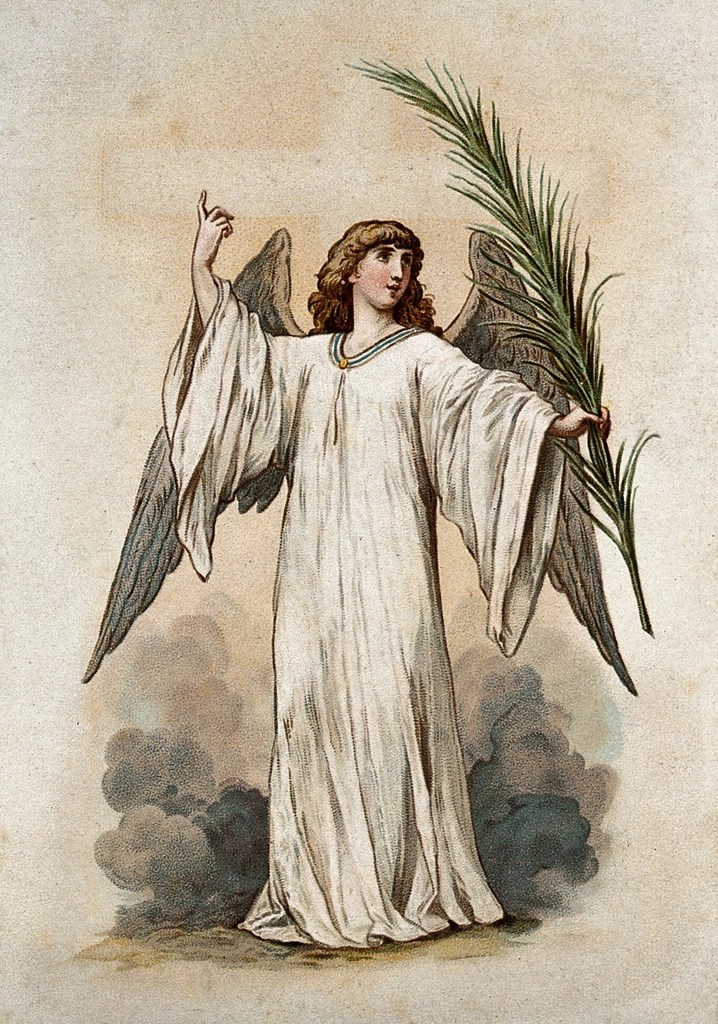
- “palm branches” – only other place in Bible this word is used is John 12:13 where Jesus is entering Jerusalem to die.
- 7:14 – “out of the great tribulation”
- “the” is implied but not in the original Greek, so it could be rendered “out of great tribulation” (KJV). In either case, it’s a picture of saints coming out of (the) great tribulation.
- 7:15 – “in his temple” – as said above, we get very clear Old Testament references (e.g. the temple) recast into its spiritual (and ultimate) endpoint: God’s heavenly presence where all Christians (not just select priests) from all nations (not just Israel) surround Him.
- 7:16-17 – hunger, thirst, tears are all done for them; this is the comfort for those going through trials and tribulations or being prepared for future trials and tribulations (which is the audience Revelation is written for)

