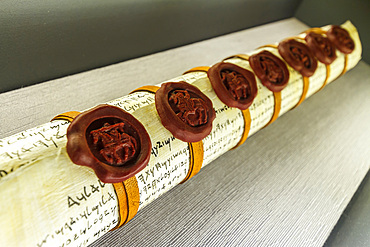
The following Revelation 6 commentary (with small additions) comes from THE REVELATION OF JESUS CHRIST (Geer & Holda, 2006).
Preface
I stand by the following words on Revelation 6, but reading it 20 years later I’d add 2 notes:
- I think this teaching is incredibly consistent with Daniel’s prophecies. In Daniel 2 & 7 you have mention of 3 world powers (Babylon, Medo-Persia, Greece) followed by another (Rome). The rest of Daniel outlines in great detail the first 3 world powers, but never says anything more of Rome. This is all the more odd when you consider Rome is pictured as a beast greater than and unlike all the kingdoms preceding it (see Daniel 7). However, the missing details can be better understood in light of the fact that Daniel ends with a sealed scroll with yet-to-be-discovered prophecy (see Daniel 12) where Revelation begins with a sealed scroll opening (Revelation 6 gets to the juicy parts of that opening, while Revelation 1-5 is introductory of the opening). Thus Daniel is Part 1, and Revelation is Part 2. Reading Daniel alone would make us anticipate that it needs a “Part 2” and this “Part 2” should talk about Rome. Thus, we’d expect Revelation to cover Rome from the time of John writing Revelation onward. This was added confirmation I didn’t see when I first wrote this 20 years ago.
- Though my own convictions have strengthened that Revelation 6 speaks to prophetic events of Rome from the time of John onwards, I also maintain that many God-fearing, Jesus-loving people will differ on their interpretation of Revelation 6. I pray that we all can increase our humility and wisdom on all this more as the day of Christ approaches.
–Brian Holda, May 31, 2026
Seals 1-4; Four Horsemen (Revelation 6:1-8)
The first 4 seals are connected (like trumpets and bowls; also like days of creation).
The 4 horsemen echoes Zechariah 1 (and 6) wherein a similar image represents God’s hand upon world nations with particular attention given to how such a nation (or nations) impacts God’s people.
Seal 1: Rev. 6:1-2 – White Horse
Rider on white horse with bow and crown is not Christ (compare 19:11-15). Rider is world power Christ starts work with to make kingdom of world into kingdom of God (11:15). White = something good; bow and crown = armored authority, expansion of territory in conquest. According to E.B. Elliot’s Horae Apocalypticae, Rome used spears and swords, not bows and arrows. but one territory in Rome was noted for bow-and-arrow: Crete. Their coins and other emblems reflected this. The first ruler during this “golden age” (which seems depicted by this white horse) was Nerva. Remarkably, he was a descendant of Crete and thus an outsider to Italy, yet still was able to reign. He then adopted Trajan, the next ruler. Thus this golden age of Rome started with someone from Crete which was known as a bow-and-arrow territory. This is a possible reason the rider is depicted with a bow in a time when Rome didn’t use this as their common weaponry.
Fulfilled: period following Domitian (ruler when John wrote) is Golden age of Rome. Nerva, Trajan, Hadrian, Antoninus Pius and Marcus Aurelius A.D. 96 to A.D. 180. Gibbon says: “the happiest and most prosperous period in entire history of human race”
Seal 2: Rev. 6:3-4 – Red Horse
Blood, war, fire; peace is taken from earth, civil wars occur
Fulfilled: A.D. 200 to A.D. 300 had fifty different emperors. They were fighting amongst themselves. Hundred years of Civil War – Rome lost more than half its population. (Halley’s Bible Commentary)
Seal 3: Rev. 6:5-6 – Black Horse
Darkness, despair; “pair of scales” = food sold by weight. Food is scarce.
6 – denarius = day’s wage; food sold by weight; “oil and wine” = luxuries abundant
Fulfilled: result of civil war foretold in second seal. Empire had worst of famines and shortages. Rulers had much wealth, but people had zero.
Seal 4: Rev. 6:7-8 – Pale Horse
Sickliness; fourth of earth killed with sword, hunger, death, and wild animals
Fulfilled: during civil war of A.D. 200 to A.D. 300, many people died and there was enormous increase in wild animals, bubonic plague also broke out.
Seals 5-6 (Revelation 6:9-17)
9 – souls had been slain = Christians being/been martyred
Fulfilled: 10 Imperial Persecutions of Church from Nero A.D. 64 to Diocletian A.D. 305 (Halley’s Bible Handbook)
11 – white robe = righteous works; “little while longer” or “a little season” = A.D. 300 – A.D. 313, Christians encountered last and greatest imperial persecution.
Fulfilled: Empire ceased its persecution of the Church.
12 – earthquake = revolution, upheaval, shakeup; sun and moon = symbols of authority in human government
13 – stars = spiritual powers (1:20)
14 – sky receding = removal of spiritual powers; mountains and islands = governments and nations (Is. 49:1); shows that the powers of government will change (Is. 13:10; Eze 32:7; etc.)
15-17 – the upheaval of government is directly related to Christ, all those who were not Christians now fear Christianity because of the revolutionary change. The language of hiding in in the caves and rocks because of fear of God’s judgment is similar to Isaiah 2:19-22. In both places it seems like it’s talking of an event preceding the ultimate judgment when Christ returns while having language that yet echoes the last day judgment.
Fulfilled: Emperor Constantine became a Christian (A.D. 312). Issued an Edict of Toleration (A.D. 313). Made Christianity the religion of his court. In A.D. 325 he issued general exhortation to all to embrace Christianity. Moved his Capital to Constantinople. Theodosius (A.D. 378-395) made Christianity the State Religion of Empire, and Church Membership Compulsory. A.D. 395 the Empire was Divided: the West with Rome its Capital; the East with Constantinople its Capital. This was the beginning of the break-up of the Mighty World Empire that had for 300 years tried so hard to destroy Christianity (Halley’s Bible Handbook).
(For more details: http://www.ao.net/~fmoeller/7seals.htm)

