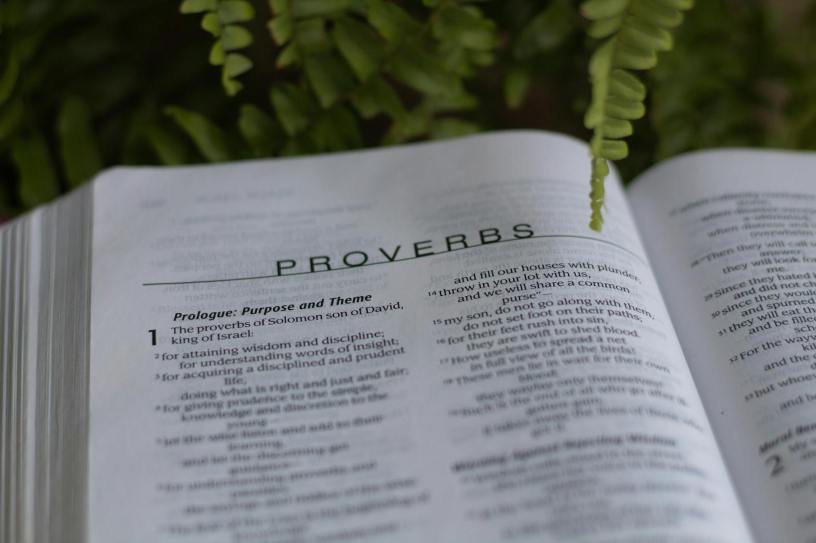
Bruce K. Waltke wrote a masterful 2-volume work on Proverbs, see New International Commentary on the Old Testament’s The Book of Proverbs.
In 2021, this was pared down to a 1 volume shorter commentary (but still 472 pages), see Proverbs: A Shorter Commentary. I would highly recommend this work for anyone studying Proverbs. It is a bit academic, but not nearly as much as the original 2-volume work.
Here is my paraphrase on some of the big ideas about Proverbs presented in the 62 page Introduction.
Title
- The title “Proverbs” comes from this first word of the book (a common practice for the title of other Old Testament books).
Structure & Authors
- Based on headings and structure, there are 7 collections of Proverbs within this 1 Book of Proverbs:
- Collection 1 (1:1-9:18)
- author: Solomon
- Collection 2 (10:1-22:16)
- author: Solomon
- Collection 3 (22:17-24:22)
- aka “Thirty Sayings of the Wise”. “Its preamble and especially its first ten sayings have striking similarities with the thirty sayings of the Egyptian Instruction of Amenemope (ca. 1186-1069 B.C.),” (Waltke & De Silva, p. 4)
- author: “identified as ‘sayings of the wise,’ were probably adopted, adapted and appended by Solomon” (Waltke & De Silva, p. 6)
- Collection 4 (24:23-34)
- author: “identified as ‘sayings of the wise,’ were probably adopted, adapted and appended by Solomon” (Waltke & De Silva, p. 6)
- Collection 5 (25:1-29:27)
- author: “men of Hezekiah” retelling some of Solomon’s proverbs
- Collection 6 (30:1-33)
- author: Agur
- “Agur son of Jakeh, unkonwn and undated, is not a king. He was likely a court official, since he supports dynastic succession and strong kingship (30:22, 31) and his son Ithiel seems to be a budding court official (30:32-33).” (Waltke & De Silva, p. 9)
- author: Agur
- Collection 7 (31:1-31)
- author: King Lemuel
- “Lemuel, also unknown, is referred to as a king (31:1),” (Waltke & De Silva, p. 9)
- author: King Lemuel
- Collection 1 (1:1-9:18)
Poetry
- Proverbs is written in poetry. Biblical poetry: (1) is terse, (2) uses imagery, (3) has parallelism.
The Wisdom Genre
- Proverbs is considered biblical “wisdom literature” (along with books such as Job and Ecclesiastes).
- This type of literature is where, “sages gained revelation through keen observations of nature and humanity and their cogitations upon them, which are informed by the fear of I AM [God].” (Waltke & De Silva, p. 16)
- Biblical wisdom literature is impossible to understand outside of revelation from God (Prov. 30:1-6; Job 8:31-41; etc.)
- Biblical proverbs are sayings that make the most sense to those who fear God (see Prov. 1:20-21; 8:1-3; etc.). Think of it like Jesus’ parables.
- “Users of proverbs must choose from the diverse sayings and admonitions the one that best ‘hits the nail on the head.’…Proverb use is always situational.’ A proverb is always true, but it may not be true for a given situation.” (Waltke & De Silva, p. 18)
- Proverbs were composed in court settings (1:1; 10:1; 25:1; 31:1; etc.), but intended to circulate via the home (e.g. 1:8; 6:20; 10:1)
Theology
- Proverbs clarifies and gives examples for the broader Law of Moses. For instance, we are told in Exodus 20:13 not to murder, whereas Prov. 25:21 says: “If those who hate you are hungry, give them food to eat.” Thus all the Old Testament speaks out of the same worldview, but proverbs express it differently than laws and oracles.
- “Proverbs refers to God in 100 of its 915 verses–over 10 percent–and, more specifically, eighty-seven times by his covenant-with-Israel name YHWH (I AM). In contrast, the name “God” (elohim) occurs only five times and signifies God’s eternal might and power over all mortals (cf. Num. 23:19).” (Waltke & De Silva, p. 24)
- God is pictured as sovereign: “Nothing is hidden from his eyes (5:21; 15:3; 22:12), and nothing operates outside of his will. Even the king’s heart, inscrutable to other humans (25:3), is but a stream of water in I AM‘s hands that he directs as he sees fit (21:1)…I AM even rules over chance. Humans throw a die and call it chance, but it is I AM who determines which way it ends up (16:33).” (Waltke & De Silva, p. 25)
- Proverbs need to be read as a unit. There is no saying that gives the whole picture, since “reality is too rich and complex for that,” (Van Leeuwen as qtd by Waltke & De Silva, p. 26).
- Wisdom is a theme of Proverbs and “mainly denotes the skill to navigate through the maze of life so that one conducts one’s life to the greatest benefit of oneself and the community; it is the way of eternal life.” (Waltke & De Silva, p. 28)
- Proverbs is part of God’s written, infallible, inspired word. “Every word of God proves true” (Prov. 30:5).
- Woman Wisdom in Proverbs is a personification of the Proverbs themselves. Shoutout to Seanathair Carmody who enhanced this by explaining how societies and tribes start with a father and mother often. Thus, God the Father/Creator is creating everything alongside Lady Wisdom. Together they are undergirding the whole of creation and society.
- The “righteous” and “wise” in Proverbs are 2 different ways of speaking to the same person or concept. They might be summed up this way: “Put simply, the righteous disadvantage themselves to advantage the community; the wicked disadvantage the community to advantage themselves.” (Waltke as qtd by Waltke & De Silva, p. 36)
- “Proverbs is a ‘how to be’ book, not a ‘how to get’ book.” (Waltke & De Silva, p. 41)
- The promises of Proverbs:
- Are mostly validated by experience
- Represent the truth, but not the whole truth
- Focus on the future when the righteous rise (see Prov. 24:16)…even if it happens after death
- Proverbs is oriented to the male:
- For example:
- many references to the father addressing his son
- son is warned against an unfaithful wife
- Woman Wisdom addresses the males in the gate (8:4)
- etc.
- This may be because:
- men take on leadership in defining the family’s identity and values (Prov. 4:3-4; Num. 30)
- men take more risks in leaving the family/cultural norms, thus need to be curbed back
- For example:
- Proverbs doesn’t overly safeguard the children, but actually shows them what wicked men and unfaithful women look, sound, and feel like. However, this is the parents explaining that to their children, thus they are graphically exposed to the bad in a safer context.
- The New Testament liberally applies the Proverbs and sees it as God’s word (we should do likewise): 2 Pet. 2:22 (with Prov. 26:11); Jude 12 (with Prov. 25:14); 2 Cor. 8:12 (with Prov. 3:7); James 4:5 and 1 Pet. 5:5 (with Prov. 3:34); Heb. 12:13 (with Prov. 4:26); Rom. 6:23 (with Prov. 10:16); 1 Pet. 2:17 (with Prov. 24:21); Rom. 12:20 (with Prov. 25:21-22); 2 Pet. 2:2 (with Prov. 26:11); Matt. 6:11 (with Prov. 30:8).
- Heb. 12:5-6 actually quotes Prov. 3:11-12 as God’s own words to the church!
- Woman Wisdom is a type for Jesus Christ. Both existed with God before all things, played a role in creation, descended from heaven to dwell with humanity though they were rejected by the masses, lead those who listen to life and immortality and threaten death to those who do not.
- “Typology, however, is not identity. Rather, the antitype will be similar and yet superior to the type.” (Waltke & De Silva, p. 61).
 fmi360