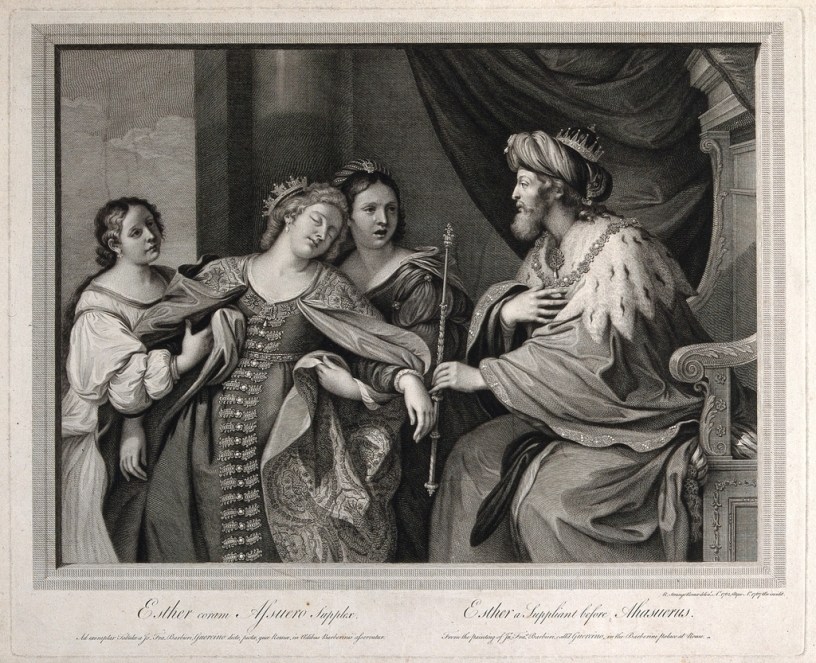
By Bruce Van Antwerp, his chosen book for monthly Bible Study, 02/08/2026
Contents: Esther Audio | Esther Outline | Children of Promise | Cry for Mercy Prayer | Miss Universe | Fasting — Isaiah 58 | Fasting Teaching
Esther Audio
Esther Outline
ESTHER in Post Exilic Sequence
| Daniel exiled to Babylon 605 or 526[1] BC | Jerusalem destroyed. Exiles to Babylon 586 or 507 BC | First exiles return to Judah 538 or 458 BC | Temple completed 516 or 436 BC | Xerxes becomes Persia king 486 or 406 BC | Esther becomes queen 479 or 400 BC | Haman’s decree to destroy Jews 474 or 395 BC | First feast of Purim 473 or 394 BC |
Major Themes
- God’s Sovereignty & Loving Care of His People
- King Cyrus’ Prophecy (Isaiah 44:28,45:1-4) Written about 681 or 601 BC.Key: Dead Sea Scrolls; History (Ezra 1:1-4) 538 or 458 BC
- Miss Universe; Children of Promise
- Fasting
- The Hebrew words for fasting mean to cover over the mouth, to afflict oneself.
- The Greek word in the NT, like Hebrew, also means to abstain from all food, voluntarily denying legitimate physical needs for higher spiritual goals.
- Isaiah 58 Adaptation; What kind of fast pleases God? Challenge: Fast and donate money not spent.
- Biblical Fasting
- God’s response to Corporate Fasting: Psalm 81:8-16 Seeking God
- Wholeheartedly (6 times in Psalm 119)
- Ask: Who fasted? Why? How did God respond?
- King Jehoshaphat (II Chronicles 20:1-29)
- Nineveh (Jonah 3:1-10)
- Esther (Esther 4:1-5:5)
- Additional important Fasts:
- Moses (Exodus 34:28; Deut. 8:9) and Jesus (Mt. 4:1-11), 40 days
- King David: openended, 6+ days (II Samuel 12:15-23)
- Ezra/Judah (Ezra 8:21-23); Nehemiah/Judah (Nehemiah 9:1-3)
- The church at Antioch (Acts 13:1-3) While worshipping & fasting, the Holy Spirit told them to commission Saul & Barnabas for missions.
- Noteworthy: After God Blinded Saul on the Damascus road, Saul did not eat or drink anything for three days. But God did not inspire Luke to write that he fasted.
- Saul wrote about fasting (N.T. Greek word) in ministry (II Cor. 6:5, 11:27)
To the Church
The following quotes are not about fasting, but rather about Bible study and the Church being salt and light in society. They are excerpts from American Family Association’s publication The Stand. AFA is one of the strongest champions of proclaiming truth & righteousness in America.
Key point: The challenge to the Church from those who change definitions:
“The deeper reason words are seen as violence is because they carry a weight that feelings cannot: an objective connection to truth. The redefinition of language is a redefinition of reality. We cannot fully escape the edges of actual reality crashing against our perceptions–though we try. And when truth is replaced by emotion, the ability for meaningful discourse disappears.”
M.D.Perkins, When Did Words Become Violence? December, 2025, page 26
“Christians throughout the ages have always had to guard against their own human tendencies to drift from the truth and soften the gospel.
“It is Satan’s stratagem to corrupt little by little. He comes in, and he says, “Just shape your language a little bit for the current issues in the progressive world that we live in . . . and put it in language that will be acceptable to . . . the values of the current age.’”
Douglas Bond, the Bedrock of God’s Law Jan/Feb, 2026, page 9
AFA also has American Family Radio, its only Michigan FM Station being 91.7 in Muskegon.
I remember a hymn sung when I was a boy. Here is the chorus:
“Every promise in the Book is mine, every chapter, every verse, every line;
All are blessings of his love divine, every promise in the book is mine.”
But this is sometimes flatly untrue. Who among us can claim we will have lots of biological descendants—even some becoming kings—just because that was God’s promise to Abraham (Gen. 17:6)? Or have we been commanded to physically kill the heathen nations around us, like Israel was told to do in Canaan? While the principles behind these might be claimed (e.g., we preach the gospel to the nations, which crucifies their old life), the promise as it stood for them does not always apply. Similarly, the heart behind Isaiah 58 stands for Christians today, while the particulars of Jewish Sabbath regulations in Isaiah 58:13 (which include things like animal sacrifice, Num. 28:9-10) would not. Don’t fall for people misusing Scripture–especially for political goals–that our government has no authority to get involved in.
Conclusion: God creates everyone with purpose
(Jeremiah 1:5; Psalm 139; Acts 10:34; Romans 2:11)
Key application verse: Esther 4:14 For such a time as this . . .
[1] Many Bible scholars favor the earlier 605 date, though others argue the more recent 526 date (see Getting the Bible Right: The Persian King & Timeline Problem).
Children of Promise
Sometime before creation you were in God’s mind,
before he made the creatures of every sort and kind.
He loved and planned you to be uniquely you
and had a special dream that no one else could do.
God longed to share his glory, plus both hope and joy,
then eternal life in heaven with every girl and boy.

Now as you ponder these great truths, they’re two things you should know:
God always keeps his promises and loves his children so.
Bruce Van Antwerp.
Jeremiah 1:5; Psalm 145:13-20; Acts 10:34 & Romans 2:11; Acts 13:36
Miss Universe
Party Animal
When Xerxes, King of Persia, ruled
from India to the Nile,
he threw a party in Susa
that lasted quite the while.
He flaunted–for six months–
his glorious wealth and majesty
so his officials might become
bedazzled as could be.

Next he held a city-wide banquet
on his palace grounds.
And guests drank wine from chalices--
no limit to the rounds.
They lounged on gold and silver couches
set on marble stone,
with white, blue, and purple hangings
adorning Xerxes’ throne.

I’m sure that it is no surprise–
post guzzling too much wine–
some guests were not concerned
if they never got called to dine.
The king didn’t sit and watch.
What wine did to him, you know.
And then he thought
It’s just the time to host a royal show!
The Queen Who Refused to Be Seen Scene
When Xerxes barked his command,
“Bring out Vashti the Queen
to show off her great beauty,”
she created quite a scene;
for she refused to parade
before drunken ogling men.
Rebuffed and enraged,
the king summoned his counselors then.

“What must be done to Vashti,
according to Persian law?
She disobeyed the King's command,
as all the people saw.”
A chief counselor, Memukan,
responded to the king,
“If we don’t stop this now,
it’ll spread
like birds on the wing.

“When wives first hear of her deed,
they'll scorn their husbands too.
It is against all men,
not just an act against you.
The day they learn this news,
all women will do the same.
There'll be no end to disrespect,
they’ll bring us certain shame.

“Therefore, if it pleases you,
issue a royal decree.
Depose the Queen;
replace her with a better one than she.
You know the Medes and Persian laws
cannot be repealed,
if you don't stop rebellion now,
our doom is surely sealed.

“But when your edict’s proclaimed
in every province of the land,
respect for husbands, once again
will take its proper stand.”
Since the King and his nobles
were quite pleased with this advice,
the law Each Man Rules His Household
was issued in a trice.
The Beauty Pageant
Once the King’s anger subsided,
he remembered Vashti’s charm;
and suddenly it dawned on him,
his life would suffer harm.
Without his Queen beside him, there,
he somehow felt alone.
His attendants then proposed:
“You don’t have to sit and moan.

“Appoint a commission now
in every province of your realm;
when their most lovely girls are found,
it will not overwhelm.
Next, bring them to your palace,
put them through a beauty school.
Then you’ll choose another queen,
the one who most makes you drool.”

This advice so pleased the King
he followed it to a T.
His order and edict were proclaimed
both near and distantly.
Many girls were brought to the palace,
placed in Hegai’s care;
No pageant had such beauties--
they could make a mummy stare.

One girl caught Hegai’s eye;
She got the best suite in the place.
She had an extra spark
beyond lovely figure and face.
Named Hadassah, called Esther,
raised by cousin Mordecai,
she glowed with an inner beauty
that no one could deny.
Party Animal Crowns Miss Universe Mrs.
Since Mordecai had warned Esther,
“Don't reveal you’re a Jew,”
not one in the palace suspected this.
Nobody knew.
Before they went to the king,
girls had beauty treatments for a year:
Cosmetics, perfumes, and myrrh --
all that royalty held dear.

Though each girl could also bring
whatever she desired,
Esther won favor by asking advice:
“Please, Sir, what’s required?”
When Esther was brought to King Xerxes,
she entranced him so.
Her spirit moved him to exclaim,
“She is the one, I know!”

The King was drawn to Esther
far more than all the other girls.
She won both favor and blessing,
he found his pearl of pearls.
He set a crown upon her head;
again, he had a Queen.
Who’d imagine a Jewess
in this Medo-Persian scene?

Xerxes held a sumptuous banquet–
the party of the year–
for his ruling officials,
to honor his Queen so dear.
He made that day a holiday
(celebrated everywhere),
and gave away so many gifts,
you’d wish you were there.
Private Eye Mordecai
Soon Mordecai came by
to give Esther a father’s advice;
But since her time was scheduled now
he couldn't sneak in like mice.
While standing at the gate,
he heard a plot to kill the King,
then told it to the Queen
so she could stop this awful thing.

When his queen alerted him,
King Xerxes quickly checked it out
and confirmed two bodyguards
were planning his death, no doubt.
The Queen gave credit to Mordecai;
they wrote down his good deed.
Those two knaves were stopped
because the king had a friend in need.
Haughty Haman’s Hatred
In time, Xerxes had Haman named
Top Noble in the Land
and commanded all, “Bow down to him.
Don’t you dare to stand.”
But Mordecai didn’t kneel.
He was a God-fearing Jew;
though opposed, he wouldn't give man
what only God was due.

When Haman saw him standing,
continuing to refuse
to bow like everybody else,
he schemed to kill all Jews.
Overcome with red hot rage,
he slyly entrapped the king:
“Grant me the right to kill some scoundrels
doing their own thing.”

He offered a mountain of silver,
all the wages due
those who’d execute the law
and, unspoken, every Jew.l
King Xerxes gave him his signet ring,
said, “Do as you please.
Thanks for squashing rebellion--
you don’t have to pay for these,”

Haman, rubbing his hands with glee.
jubilant as could be,
quickly proclaimed throughout the realm
this royal decree:
“On the 12th month, the 13th day,
scour all your neighborhoods.
Kill every Jew, young and old,
and then you may plunder their goods.”
All Day Mourning Mordecai
After this edict was issued,
the King and Haman shared a drink;
but the people were bewildered,
didn't know what to think.
Mordecai mourned in sackcloth and ashes--
such awful news.
Wherever this law was read,
there was fasting among the Jews.

Mordecai sat near the palace wall,
wailing bitterly.
When told, Esther sent her servant,
“Learn why. Then come tell me.”
So Hathak went to Mordecai,
who told him everything,
including the sum of money
Haman promised the king.
Mordecai Appeals to the Very Appealing Queen
Mordecai gave him the text--
the edict to kill all Jews--
asked Esther to go to the king,
exposing Haman’s ruse.
“Beg him to extend us mercy,
plead with him for us all.
Since you’re his favorite,
why would he deny you, or stall?”

When Esther heard this, she said,
“I thought that everyone knew.
It's law. No one may approach the king;
he must summon you.
Since he’s not called for me
in the last thirty days--I’m scared;
for I cannot forget
just how my predecessor fared.”
For Such a Time as This
Yes, she recalled Queen Vashti,
and what Xerxes did to her.
If he didn't extend his scepter,
then her death was sure.
(Picture yourself as Queen Esther.
Wouldn’t you be afraid,
with the future of your people
on your shoulders layed?)

Once Esther's message was relayed,
Mordecai gave reply:
“Since you are in the palace,
are you the sole Jew who won't die?
Please don't stay silent at this time,
and don't take this amiss.
Perhaps you’ve come to the kingdom
for such a time as this.”
Quick To Fast
Soon Esther replied: “To all the Jews.
Don’t eat or drink three days;
I and my maids will fast the same,
seek God's way through this maze.
In spite of the law,
I promise you, I will surely try.
Afterwards, I’ll see the king--
and if I perish, I die.”
From Fast To Feasts
When three days passed, she dressed her best,
went to the inner court;
and I’m ecstatic that I
can give you this great report:
The King extended his scepter
and asked, “What’s your request?
I'll give up to half my kingdom,
for you deserve the best.”

“If it pleases you,”Esther said,
“I've planned a feast for you.
And if you approve,
I’d like to invite Haman too.”
“Bring him at once,” the king ordered.
“Let’s do what Esther asks.”
Quite soon Xerxes and Haman
were sampling vintage casks.

(Imagine a royal banquet:
the King, the Queen, and you.
Could life get much better than that,
no matter what you do?)

Once again the King asked Esther,
“Now what is your request?
I'll grant you up to half my realm.
With you, I am so blessed.”
“If you, O King, favor me,
this is what I wish you’d do:
Let’s feast again tomorrow;
then, I promise, I’ll tell you.”
Gallows Humor
Haman left, his spirits high;
he was happy as can be.
Two banquets with the King and Queen,
an honor all could see.
When Mordecai didn't rise,
or kowtow as he went by,
Haman boiled with white-hot rage
and vowed, “Mordecai must die!”

Calling his friends and wife,
Haman bragged, “See my power, fame:
I feasted in the palace;
tomorrow I’ll do the same.
Yet it dulls my delight
when I see that Jew at the gate.
I know we’ll kill them all,
but I long to hasten his date.”

They all counseled,
“Build a gallows seventy-five feet high.
Ask the King tomorrow--
it will be fun to watch him die.
Then go to your feast, be merry,
enjoy life to the hilt.”
So, enraptured by this thought,
Haman had the gallows built.
Past Bedtime Story
That night, Xerxes couldn't sleep,
and ordered his chronicles read;
he heard Mordecai saved his life
from those who wished him dead.
“What honor did Mordecai get
for doing this great thing?”
When told “Nothing,”
“Why not?” burst from the incredulous king.
Haughty Haman Eats Crow
At that moment, a tumult arose
in the outer court.
Haman came to see the King
and give his “gallows report.”
After he entered, the King told him,
“Please give me a plan.
When I have someone to thank,
how should I honor that man?”

Now Haman, so conceited, thought
Who’s more worthy than I?
No one deserves more praise than me.
Then he said with a sigh:
“To honor the man who delights you,
treat him royally,
and give a showy parade
for all the city to see.

Dress him in your royal robe,
place him on your crested horse;
have your highest noble prince
lead him through a downtown course.
To further honor this man,
have the prince yell at special sites:
‘This is done to honor the man
in whom the king delights!’”

“Go at once,” the King commanded,
“get the robe and the mount.
Do this for Mordecai;
I’ll want to hear a good account.”
So Haman robed Mordecai,
and led him through the city roads,
heralding the King's honor--
mentally kicking his goads.
Trapping a Rat
After reaching the palace,
Mordecai sat by the gate;
but Haman rushed straight home
to tell his wife and friends his fate.
With one accord they said,
“You're doomed. No wonder you're so scared.”
Then the King's servants took him
to the feast Esther prepared.

The King and Haman dined
with Queen Esther a second day.
Xerxes asked his Queen,
“What’s your wish? What do you want to say?”
Then Queen Esther answered,
“If it pleases your Majesty,
grant me my life, spare my people.
It’s terrifying me!

I and my people have been sold
for destruction and death.
The evil scheme against us
all but takes away my breath.
If we’d been just enslaved,
I wouldn't have disturbed the King …”
Then Xerxes exploded,
“Who’s dared this despicable thing?”

Esther answered,
“Haman is our enemy. He is so vile.
He’s plotted to destroy us Jews,
deceived you all the while.”
The king arose in a rage
and stormed out through the nearest door;
but Haman, sensing his fate,
implored the queen all the more.
Justice
As Xerxes returned from the garden
to the banquet hall,
he saw Haman begging the Queen,
trip on her couch and fall.
The King exclaimed, ”Has he no shame?
Take him from my sight.”
And told of the gallows, ordered,
“Hang him there by tonight!”

That same day King Xerxes
gave Esther Haman's vast estate,
and promoted loyal Mordecai,
his advice first rate.
Again, Esther pleaded with the King,
weeping at his feet,
implored, “Can you kill Haman’s plan,
or the edict delete?”

Since the King’s law couldn’t be stopped,
he wrote a new decree;
and everywhere this edict went,
the Jews were filled with glee.
The day Haman had schemed their deaths,
they overwhelmed their foes.
Now it is a holiday,
a theme of poetry and prose.
Your Place In God’s Kingdom
Remember when your life is hard
that fasting moves God’s heart.
He’s mighty to defend you
and can stop each fiery dart.
We all have hostile foes;
life’s not just beauty and bliss.
Perhaps YOU’VE come to the kingdom
for such a time as this.
–Mr. Bruce
Fasting — Isaiah 58
Edited for rhythm/reformatted 02/27/2025
Bruce Van Antwerp
“Shout it aloud, no inside sounds,
raise your voice like a horn.
Declare to my people their sins,
rebellion I have borne.
For daily they seek me,
seem eager to know my way,
as though a righteous lot
wholeheartedly bowing to pray.

“Though they’ve forsaken all commandments
of their loving God,
though their sins walled me out,
yet, somehow, they still think it’s odd
that when they ritually pray,
they sense I am not near.
And after petitions, they mourn,
protest that I don’t hear.”

“Why have we fasted?” they demand.
“You clearly have not seen.
We’ve humbled ourselves in vain.
What could this possibly mean?”
God answered, “People, listen up.
Now you should make this choice:
You must unstop your stubborn ears,
before you’ll hear my voice.

“For on the days you fast,
indulging yourselves as you please,
exploiting all your laborers,
your works, to me, are sleaze.
You quarrel, strive, and fight–
all while you piously fast.
You fail to see hypocrisy
leaves me appalled, aghast.

“You cannot fast like this,
expecting to be heard on High.
If you won’t change your ways,
why should you even try?
Is bowing your head like a reed
so all the people see,
and humbling yourself in sackcloth
a valid fast to me?

“Now hear the fasting I accept,
the fast which I approve;
and do these acts of service
if my heart you would move:
Break bonds, loose chains of injustice,
set oppressed people free,
and share your food with those in need–
treat them as you’d treat me.

“Give clothing to the destitute,
and shelter homeless poor;
do not neglect your family–
do all of these and more.
For then your light will shine like dawn,
your healing soon appear;
Your righteousness will light your path,
the LORD will guard your rear.

Then when you call, God will respond.
Cry, “Help!” He’ll say, “I’m here--
but stop oppression, pointing fingers-
that’s when he’ll draw near.
Do all these gladly from your heart,
the LORD will be your Guide.
He’ll keep you fed in famine time,
in health when others died.

“You’ll thrive like well-watered gardens,
like an unfailing spring,
be called Repairer of Broken Walls,
the Home Restorer King.
Esteem the LORD’s Day–it’s holy–
not doing as you please.
It’s then you’ll find joy in the LORD,
and feast on high in ease.”
What Does the Bible Teach About Fasting?
Bruce Van Antwerp
Fasting. What a topic for discussion . . . and controversy.
Since modern medicine discovered a plethora of fasting’s health benefits, it seems that non-religious people are promoting fasting more zealously than American Christians. Why? The Old and New Testaments and Jesus all taught the importance of this spiritual discipline.
Let’s bypass opinion and begin studying fasting in the Bible by checking the Bible’s words for fasting and their definitions (Strong’s Exhaustive Concordance).The OT Hebrew words mean the covering of the mouth, of afflicting oneself. The NT Greek word, which, like the Hebrew, also is motivated by seeking God. Fasting involves voluntarily abstaining from all food and/or drink (legitimate physical needs) while prioritizing seeking God and higher spiritual needs.
When approaching the Bible, I cannot overstress that I believe in verbal, plenary inspiration of the Scriptures. Simply, the Holy Spirit moved upon human authors to speak God’s very words (II Timothy 3:16; II Peter 1:20-21). I have also endeavored to be faithful to Paul’s instruction to Timothy (II Timothy 2:15): “Do your best to present yourself to God as one approved, a workman who does not need to be ashamed and who correctly handles the word of truth (NIV 1984).”
Scripture records about 70 references to fasting. There are several types of fasts: individual e.g. Nehemiah (Nehemiah 1:4), corporate, e.g. all the Jews in Susa (Esther 4:15-17), and scheduled, e.g. Israel’s Day of Atonement, Yom Kippur (Leviticus 3:26-27; Acts 27:9, affliction identified as fasting). Especially study Isaiah 58!
When King Jehosaphat called for a corporate (national) fast, all totally abstained from eating (II Chron 20:3-15). Queen Esther asked the Jews in Susa to fast all food and water for three days before she approached King Xerxes uninvited to plead for her peoples’ lives. The Ninevites (Jonah 3, 785 BC?) called a similar, but open-ended fast of all food and water, even including all animals, after hearing Jonah’s message of judgment.
Jesus taught about prayer and fasting in the Sermon on the Mount, Matthew Chapters 5-7.
1. Prayer (Mt. 6:5-13) Privately, where only God sees you, not like hypocrites in public.
2. Fasting (Mt.6:16-18) Don’t make a show of fasting either. “Your Father, who sees what is
done in secret, will reward you.”
I was surprised by how many teachings on Daniel’s 21 Day Fast I found as I researched biblical fasting. In the specific 21 days spoken of (Daniel 10), Daniel writes that he ate no choice food or meat, nor drank wine. First, they labeled it a “partial” fast. Next, they called it a “fast.” Many sincere Christians also teach that the requested diet change, where Daniel and his three friends determined not to defile themselves with the royal food and wine (Daniel 1), is the first fast in Daniel: Daniel’s 10 Day Fast. After being granted permission for a ten day trial, their positive visible results gained permission for continuing their vegetable diet for the duration of their three year training program. May I encourage you to study out if Scripture separates this 10 day test from the remainder of their 3 year training?
The Bible records two incidents in Daniel–when God inspired the words for fasting. Daniel fasted (Daniel 9) after he discovered the 70 year duration of Jerusalem’s Babylonian exile (Jeremiah 25:11). Secondly, King Darius was so distraught after being tricked into having Daniel, his best and favorite official, thrown into the lion’s den that he fasted all night, didn’t sleep, and even went without his regular entertainment (Daniel 6). You may be familiar with watching and praying, which is refraining from sleep to pray. However, God did not inspire Daniel to write that King Darius fasted sleep and/or entertainment.
I’ll leave it up to those who believe in the literal interpretation of Scriptures to conclude whether God used word(s ) for fasting when he chose to and did not use them when he chose not to. Maybe I missed something, but I couldn’t find any Hebrew words for fasting included regarding Daniel’s diets (Daniel 1, 10)–nor find them ever cited again or copied in the Bible.
Here is my biggest concern: I’m convinced that one of Satan’s biggest tools for working his deception is incrementally distorting the definitions of God’s words (think marriage, justice, and theology) and bringing them into the Church.
I’m reminded of Abraham Lincoln asking a man, “If you call a dog’s tail a leg, how many legs does that dog have?” When the man responded, “Five,” Lincoln said, “No, calling something what it is not does not make it so.” Was Lincoln right?
What is the dictionary definition of restricting what one eats to certain foods? Already mentioned, it is Diet: a special course of food to which one restricts themself. Would anyone promote the Mediterranean Fast? The Paleo Fast? The Low Carbs Fast? The Atkins Fast?
Brothers and sisters, I encourage you to study to discern if these “Daniel 1 & 10 Fasts” differ from other human teachings which have “an appearance of wisdom” (Colossians 2:20-23).
Why do we read teachings from evangelicals about the 21 (and 10) day Daniel Fasts even while they remain silent on Chapter 9’s recorded fast? In both cases, Daniel prayed. Both times the heavenly messenger told Daniel that he was highly favored. When Daniel did a biblical fast and prayed, the archangel Gabriel came to him immediately–while he was still praying. In sharp contrast, when Daniel’s spiritual discipline was eating a restricted diet, a lower ranking angel was sent, also immediately. But he was waylaid in spiritual warfare, and Daniel didn’t get his answer for three complete weeks. Do you too wonder why anyone who loves God and knows the Scriptures promotes the latter while remaining silent on the former?
I am not ignorant that today people “fast” TV, or Facebook, or any number of other things. Language evolves.
But if these “Daniel Fasts were from God, wouldn’t we read later in the Bible where they were copied? Did Queen Esther call for a “Daniel Fast” some 60 years later before she approached King Xerxes’s throne? Did Nehemiah do a “Daniel Fast” some 30 years after Esther (Nehemiah 1:4)? Did Jesus confront the Pharisees about their hypocritical “Daniel Fasts?”
Call this spiritual discipline a Daniel Diet, and who could object?. People can sincerely seek God while practicing a restricted diet as a spiritual discipline. Romans 15:4 tells us that everything that was written was written to teach us . . .
Here is an assignment: Study to decide for yourself whether you believe this 21 Day Daniel Fast is inspired Scripture. If not, how does this not encourage and validate others to do likewise with whatever idea(s) they choose? Does sincerity validate sloppy scholarship? The prophet Malachai (2:7-8) castigated the priests for turning from the way and their teaching causing many to stumble. How can such “doctrine” be distinguished from the religious leaders trumping Scripture with their traditions of the elders–which Jesus strongly condemned (Mark 7:6-13; Matthew 15:1-9)?
What’s next? The poor man’s tithe? It’s significantly reduced, 2-4%, but yeah, it’s cool. What do you mean a partial tithe isn’t a tithe? Though not exactly the real thing, call it a tithe often enough, ‘cuz, you know, like, language evolves, and voila! It’s a tithe . . . At least we can reasonably doubt that not many pastors will elevate this manwarped concept as Scriptural truth.
Sooo . . . how about touting “fairly faithful,” “half holy,” “mostly monogamous,” and “partially pure as Biblical doctrine?” Close enough?Acceptable?
Doesn’t Scripture teach that some things are either ALL or NOTHING? If we stretch anything in the Bible that is all or nothing to include the partial, what fruit might escape from this Pandora’s Box? Be Bereans. Search the Scriptures daily. Verify the truth of what you’re taught. Here, too.
Friends, the heart of biblical fasting, as I understand it, is seeking God with your whole heart (Deut 4:29), so focused that you voluntarily abstain from all food. Having practiced spiritual fasting for nearly fifty years, I’ve seen God faithfully answer my heartcries many times as I fasted and prayed. I pray that you will further study and practice fasting. May the Holy Spirit enlighten you and guide you deeper into the heart of Jesus.
Cry for Mercy Prayer
Ps. 130:1-4; Ps. 51:1-2,10; Ps. 130:5-8
Out of the depths I cry to you, O LORD;
O LORD, hear my voice.
Let your ears be attentive
to my cry for mercy.
If you, O LORD, kept a record of sins,
O LORD, who could stand?
But with you there is forgiveness;
therefore you are feared.
Have mercy on me, O God,
according to your unfailing love;
according to your great compassion
blot out my transgressions.
Wash away all my iniquity
and cleanse me from my sin
Create in me a pure heart, O God,
and renew a steadfast spirit within me.
I wait for the LORD, my soul waits,
and in his Word I put my hope.
My soul waits for the LORD
more than watchmen wait for the morning,
More than watchmen wait for the morning.
O (people of God), put your hope in the LORD,
for with the LORD is unfailing love
and with him is full redemption.
He himself will redeem (his people)
from all their sins.

