- Bad News: Sinners & God: Leviticus 1:1–“from” (cf. 15:31; 16:1-2)
- Leviticus: atone 47 times; blood 65 times → Numbers 1:1–”in”
Leviticus 1-7: God’s 5 Offerings (cf. Hebrews 10:1-18)
- Burnt Offering = Crucifixion (Genesis 22:1-13)
- 1:3-4: male, unblemished. If that animal hadn’t died, you do.
- Grain Offering = Resurrection (John 12:24)
- Peace Offering: Like Communion
- 7:11-18: recognition of God’s peace upon you; feast with others
- Sin Offering: Blood Cleanses Sin
- Guilt Offering: Sin Offering of Restitution
Leviticus 8-10: Priests (cf. 1 Peter 2:9)
- Priests: sin & burnt offering (= Rom. 3:23-25; 6:6); ordination offering: ears, hands, feet belong to God (Lev. 8:22-24 = Romans 6:13)
Leviticus 14: Leper Restored (cf. Hebrews 9:9-10)
- Guilt offering; consecrated, anointed for service (see 14:14-18)
Leviticus 16: Day of Atonement (cf. Hebrews 9:6-10:18)
- High Priest: pure; death; come back alive (Lev. 16:1-28)
- People: afflict souls, sabbath (Lev 16:29-31)
Leviticus 18-20: Holy Walk (cf. Galatians 5:14)
Moral law carries over to New covenant (e.g. Lev 19:18 = Gal 5:14)
Leviticus 23: Feasts (cf. Col 2:16-17)
- Fulfilled in 1st Coming (1st 3), Church (4th), and 2nd Coming (Last 3)
Is God Serious About All This?
“There was once a Roman governor, who made a law prescribing death as the penalty for a certain crime. To some the enactment seemed somewhat harsh and unnecessarily severe, and it was questioned whether he really would enforce the law. But presently a circumstance occurred which forever swept away all doubt upon that point. It happened that his own son was the first offender. The boy whom he had carried in his arms, and dandled on his knee, and upon whom his heart was set with bright hopes, stood before him as the culprit. It was a case to tell all that was in that sovereign’s heart as to his sincerity when he made the law…When all the tender and softening affections which worked in that father’s heart towards his own son failed to move him from his integrity as a law-giver, and the darling object of his love and pride received the immolating sentence unmitigated from his lips…It was parental affection writing down in the life-blood of its own offspring the stern adherence of sovereignty to the terrific sentence, “The soul that sinneth, it shall die.” And when God spared not his only Son when found in the sinner’s place, but launched upon him the law’s full penalty, and put him under a curse at which the world shook and trembled, what unforgiven sinner can ever think of going unpunished?”
–Seiss, J.A., Holy Types; Or, The Gospel In Leviticus, 1910, pp. 43-44
The Gospel in Leviticus – Full Version
- Bad News: Sinners / God: Exodus 40:34-Leviticus 1:1; Leviticus 10:1-3; 15:31; 16:1-2; Romans 1:18-32
- Good News: Numbers 1:1; Leviticus: Atone 47 times; Blood 65 times: Lev. 17:11
5 Offerings: Leviticus 1-7; Hebrews 10:1-18
- Burnt Offering = Crucifixion (Gen. 22:1-13 = Heb. 11:17-19)
- 276 times in ESV Bible (59 in Leviticus)
- First offering (Gen. 8:20)
- 1:3-4: male, unblemished; touch head = atonement by life of another. If that animal hadn’t died, you do.
- Cut = intentional
- Fire = judgment
- 1:9: “pleasing aroma to the Lord”
- 6:9 “kept burning” – the provision of Christ’s cross never stop for us
- 6:1: ashes outside camp – provision of cross extends to world
- Grain Offering = Resurrection (John 12:24; 1 Cor. 15:20)
- 130 times in ESV Bible (35 in Leviticus)
- Uncorrupted, raised life — tested by fire without death; unto God first, then fuel for priests
- Peace Offering: Like Communion
- 83 times in ESV Bible (29 in Leviticus)
- Ch. 3 – Similar to and on top of burnt offering
- 6:12 – fat of peace offering continually burning atop burnt offering
- 7:20 only partake if you’re clean (see 1 Cor. 11:27)
- 7:32-34 – shared with ministering priests
- Sin Offering – Provision for sin
- 114 times in ESV Bible (51 in Leviticus)
- 5:1-4: Sins of silence, unclean, rash vows
- Both anointed priest and whole congregation require a bull; shows Jesus’s sacrifice (as high priest) sufficient for whole congregation
- Nourishes priest ministering it 6:26 (similar to healing that comes to church when sins are confessed, e.g. James 5:16)
- Guilt Offering – Type of sin offering dealing with another’s property (7:7)
- 34 times in ESV Bible (21 in Leviticus)
- Ram; make restitution + ⅕ = atonement, forgiveness
Priests: Leviticus 8-10; Hebrews 9:11; 1 Peter 2:9
- High Priest
- Other Priests = Sons of High Priest
- Consecration (Lev. 8)
- All Israel assembled; water applied – reminiscent of baptism of Jesus, and subsequently our baptism
- High Priest –
- Coat = righteousness of Christ (Rev. 19:8)
- Breastpiece with 12 tribes = God’s people on Jesus’ heart
- urim and thummim in breastpiece = Jesus determining God’s will based on heart for His people
- Anointed tabernacle and High Priest (8:12) – reminiscent of scene after Jesus was baptized
- Priest – coats, sashes, caps (like our covering in Christ [justification], or covering ourselves with ministry/righteous works as we walk in sanctification)
- Sin offering – reminiscent of Romans 3, and forgiveness of sins we first receive
- Burnt offering – reminiscent of Galatians 2:20, and the death of self through Jesus’ cross
- Ordination offering (8:22-24) – reminiscent of Romans 6:13 and our consecration to God
- Anointed High Priest and priests with oil, blood (8:30) – our sanctification and anointing with the Holy Spirit
- Ministry (Lev. 9)
- Begins on 8th day (8 = new beginning: 8 people on ark, circumcision the 8th day, 1st day of new week, David is 8th son, etc.)
- People bring sin, burnt, peace, grain offerings – the people had to reach out and take hold of the sacrifices in order for the priestly ministry to affect them (similarly, we must receive Christ in faith and repentance in order for His priestly ministry to take effect, e.g. John 1:12)
Uncleanness: Leviticus 11-15; Hebrews 9:9-10
- Lev. 11: What We Take In
- Unclean: attachment to world (e.g. Lev. 11:21)
- Lev. 11:36-37: Perpetually clean = seed (Luke 8:11) and well (John 7:38-39)
- Lev. 12-14: What Is Within
- 12; 15: new life starts from uncleanness; our blood and “water” = unclean
- 13:1-4: leper identified
- Identifying depth and breadth of uncleanness
- Brought to priest
- Priest pronounces “unclean”
- 13:45-46: leper banished, cries “unclean”
- 14: leper restored
- 14:1-3 brought; priest outside of camp
- 2 birds
- Wash – like baptism or the washing of the water of the word
- Guilt offering shows the leper was God’s property that had to be restored – he belonged to God, and when he is cleansed it is unto service for Christ
- 14:14-18 – consecrated and anointed; similar to priests; restored leper is like the restored sinner who becomes a priest (1 Pet. 2:9)
Day of Atonement: Leviticus 16; 23; Hebrews 9:6-14
- Lev 16:1-3: “in this way Aaron shall come”
- Gospel picture – God’s role (see 1 Cor. 15:1-4):
- High Priest & Sacrifice had to be pure = Jesus’ pure life and sacrifice (1 Pet. 1:19)
- Atonement required death, blood
- If High Priest comes out alive, sins are atoned
- Lev 16:20-21: sins completely transferred to another
- Gospel picture – People’s role (Lev. 16:29-31; see Mark 1:15). People:
- afflict souls = repentance
- Sabbath = trust/faith in the work of the High Priest, not you
- Leviticus 23 shows the sternest warning against breaking sabbath on Day of Atonement. Shows God’s unswerving standard that atonement does not come through the effort of man (cf. Gal. 1:6-10).
- Lev 16:34: Result = atonement
Holy Walk: Leviticus 18-20; Galatians 5:14
- Moral law carries over to New covenant (e.g. Lev 19:18; Gal 5:14)
- Laws of sexuality carried over to New Covenant (cf. Romans 1)
- Outward ritual not carried over to New covenant (e.g. Heb. 9:9-10)
Leaders: Leviticus 21-22
- Principles remain (1 Cor 9:13-14)
Feasts: Leviticus 23; Col 2:16-17
- 3 at Christs first coming
- Unleavened Bread = Jesus’ righteous life and/or ours through Him (1 Cor. 5:8)
- Passover = Jesus’ death (1 Cor. 5:7)
- Firstfruits = Jesus’ resurrection (1 Cor. 15:23)
- 1 in middle
- Pentecost = Beginning of Church (Acts 2)
- 3 ushering in his 2nd coming
- Trumpets = Announcing the Lord’s return (1 Thes. 4:16) and/or the proclamation of the gospel we do now (Ezekiel 33:5-7)
- Day of Atonement = Gospel preparing heaven (“tabernacle”) for sinners to live with God (Hebrews 9)
- Feast of Booths = End of harvest, when living in tents is a memory (2 Cor. 5:1-5; Rev. 14:14-20)
Sabbaths: Leviticus 25-26; Hebrews 3-4
- Sabbath = trust/faith in God’s work, not yours (Heb. 3-4)
- Land needed 7th year Sabbath and 50th year Jubilee
- Jubilee = The restoration when Christ returns (all return to their true home; debts released; God owns all)
Giving God More: Leviticus 27; Acts 5:3-4
In Acts 5:3-4, Ananias and Saphira were confronted that they didn’t have to give all their property (“Didn’t it belong to you before it was sold? And after it was sold, wasn’t the money at your disposal?”). Their fatal sin was lying to the Holy Spirit (Acts 5:3).
Saying that, the picture in Acts 2:44-45 and 4:32 of sharing all they had, is seen as praiseworthy and good.
Leviticus 27 might show a picture of what it looks like to willingly offer ourselves to the Lord, not just at a base level. It is a fitting and modest gift discussed at the end of Leviticus, after considering all of the sacrifice offered earlier on God’s behalf (ultimately culminating in Christ).
Other Misc. Notes
From Seiss, “Holy Types”:
- P. 14 – “Leviticus” = “What Relates to Levi”
- P. 14 – More “God said” than any book
- P. 15 – Leviticus points to Christ
- P. 17 – Gospel defined: “God in Christ reconciling the world unto himself.”
- Brian: God atoning sinners through Jesus’ life, death, and resurrection. We respond by repenting and believing.
- P. 19 – Lev. summarized
- Pp. 25-26 – 40 days for tabernacle; 30 days for Leviticus; 6 days for creation: God’s redeeming work is greatest glory.
- P. 33: holocaust = “whole burnt offering”
- Burnt offering: uncovered; outer and inner judged together; fire and wood means of judgment; unless sinner touches head, no atonement and they take that judgment instead
- P. 95 – ashes are like bones: represent place of burial
- P. 126 – priest publicly appointed by God first with water, oil following = Jesus baptism
- P. 134 – had to be marked with blood before he could enter Gods presence on behalf of the people = Jesus sacrificed before going to heaven
Audio Transcript (Auto-Generated from MS Slack)
0:00: Here we go.
0:01: , I think you all have outlines, right?
0:06: if not, like I said, you can go, you can go online and not only online does it have the same outline, but it has 6 extra pages, so you can get the extended version at the website.
0:18: I’m calling this the gospel in Leviticus.
0:20: It’s another one of those books that there’s no way in an hour can do it justice.
0:23: It would take 2 hours just for us to read it right now, you know.
0:27: So trying to select in this, this is probably overly.
0:31: Brief, I mean, it really is.
0:35: that’s why I extended version for dinner, you guys, we’re here, we’re, I’m here till midnight.
0:40: Then I gotta go to sleep because we got to go to Kelvin and pray.
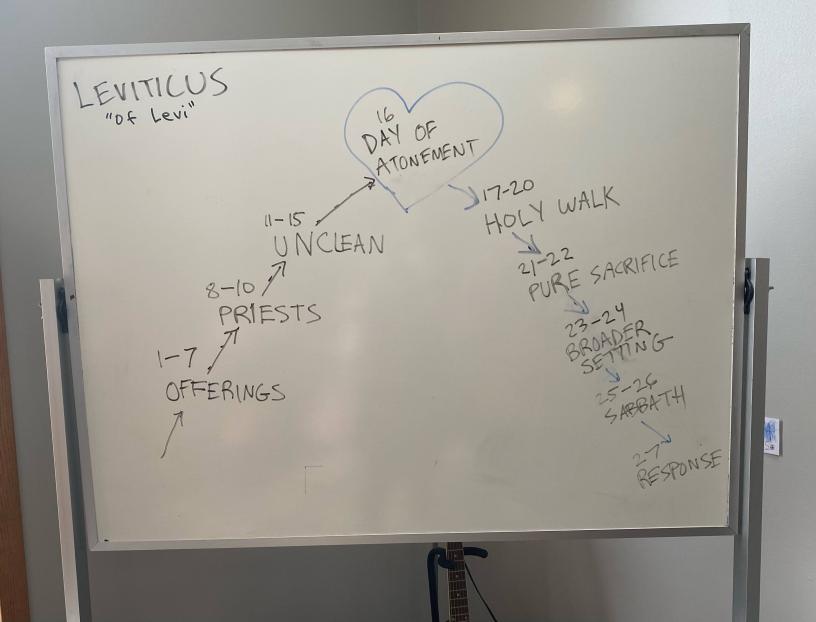
0:42: OK, anyway, so, the, the arc, this is how I kind of envisioned the Leviticus, first off, it means of Levi.
0:51: It is instructions for the priest, that’s kind of where that came from, as I understand.
0:57: And I see it as largely an arc.
1:01: That, the heart of Leviticus, the day of Attoma, and if you think about it, the heart of the Torah is Leviticus.
1:07: It’s right in the middle of the five books of, 1st 5 books of the Bible, Torah.
1:11: Then you have Leviticus, and then right in the middle of Leviticus you have the Day of Atonement, which is a very special day which we’re gonna talk about more, but Atonement means covering.
1:21: Right.
1:21: Some people talk about is like at one mint.
1:23: I think that’s been hijacked by Christian Science in a bad way, but I think that’s not a bad way to say that at one mint that there’s that there is a reconciliation piece of atonement.
1:32: That is at the heart of Leviticus.
1:34: These to me are the building blocks that take you to the day of atonement.
1:39: We’ll get to the 1st 7 chapters, the offerings that establish what we’re going to use here, the priests who need to give the offerings, the bad news, what makes you unclean.
1:51: The Day of Atonement, which is the day of complete covering by the high priests, and then you get to the outcome of it.
2:01: Others have said that the 1st 16 chapters is kind of like the doctrinal portion, like it’s like Romans, you know, 1 through 1 through 8 maybe, or 1 through however you look at it, and the rest are the application portion, you know, the rest are Romans or Ephesians gives that sit walk stand.
2:17: Some people have heard of that before.
2:17: It’s like that’s the doctrinal pieces up to here.
2:20: The application piece goes down here, leaks leads into the holy walk you have.
2:26: This talks about what is a pure sacrifice.
2:28: This puts the day of atonement in the broader setting.
2:31: This establishes Sabbath, which is a big part of the Day of Atonement.
2:34: We’ll get to that in a bit.
2:35: And lastly, the last chapter, depending on how much time we have, we might look at it in Leviticus is voluntary offerings.
2:43: You see your house, you see, your, your, your own life, the life of your children, the life of your animals, and you say, how can I not give it to God?
2:52: Well, how do you voluntarily give that over to the Lord is what it talks about in the end of Leviticus.
2:58: So I hope you see this as kind of the arc.
3:00: Let’s open up now to remind us where we left off because Leviticus doesn’t, isn’t the beginning of the Bible.
3:07: They got Exodus first.
3:08: So go to the end of Exodus, Exodus 40.
3:14: Excuse me.
3:22: And if, as you remember in Exodus, the latter part of Exodus is all the instructions that God gives Moses on building the tabernacle, OK?
3:31: There’s a cool book my mom brought.
3:32: Maybe you could waive that for people to look at later.
3:34: This is a cool.
3:38: It is.
3:39: I agree.
3:40: The, the, it’s a Bible books and chart.
3:42: It has a whole thing of the tabernacle.
3:43: It’s really neat.
3:44: Rich, you would love it too.
3:45: It goes in the feast and all that stuff, which, by the way, that’s part of Leviticus too.
3:48: So again, we’re not gonna, one hour, man, this, everyone’s here to see if I can do it by the grace of God, we’ll do it in 1 hour, but there’s much more.
3:55: OK.
3:56: Exodus 40.
3:58: They did the tabernacle.
4:00: They have everything built.
4:01: It’s all part of God’s revelation.
4:04: But it only gives the outward stuff, right?
4:06: Leviticus puts, puts things into the tabernacle.
4:09: It gives the priestly garments, but now it puts action behind the priest.
4:12: So Leviticus gives that.
4:13: But look at how Exodus ends.
4:15: Ready?
4:15: Exodus 40:34.
4:18: Then the cloud covered the tent of meeting.
4:21: And the glory of the Lord filled the tabernacle.
4:24: You remember that?
4:25: They built this up and God’s presence there.
4:27: That is nothing.
4:28: That tabernacle is nothing.
4:30: It’s just waves in the wind unless God is in it.
4:34: That’s what makes it special.
4:36: That’s what makes the church today who we are His tabernacles special, God in us.
4:41: So God is now in the tabernacle, verse 35.
4:45: And Moses was not able to enter the tent of meeting because the clouds settled on it and the glory of the Lord filled the tabernacles.
4:53: So you have a separation.
4:55: This is Moses even.
4:57: I mean, if, if, if you think, you know, well, maybe I’m not great, but Moses, surely he could be with God.
5:04: No, he can’t.
5:05: He’s not.
5:06: He is a sinner marked by sin, cannot be in God’s presence.
5:10: And that’s why now you open to Leviticus 1 verse one, this is on your outline.
5:14: I’m getting, I’m going to the bad news here.
5:17: 1 verse one.
5:18: Look at what it says.
5:21: The Lord called Moses and spoke to him from the tent of meeting.
5:26: Anyone know why this is a unique thing?
5:29: And God speaking to Moses.
5:33: The Lord called Moses spoke to him from the tent of meeting.
5:36: Well, hold your place there, go to numbers 11.
5:40: This is after Leviticus is done.
5:44: And see if you notice a difference.
5:49: Numbers 11 It says, the Lord spoke to Moses in the wilderness of Sinai in the tent of meeting.
5:58: Do you see the difference?
6:00: What is it?
6:01: They were, they were together.
6:03: Yeah, the first one was from the tent of meeting.
6:06: That’s God speaking and Moses is separate.
6:09: And then you have numbers 11.
6:11: They’re in, they’re able to be together.
6:13: This is because by the nature of a sinner, which Moses is one, it’s only Moses though, right?
6:18: OK, that’s all of us, by the nature of sinners, and we don’t understand the depth of our sin.
6:23: I will just say that now, and Leviticus I think will help us see that.
6:25: By the nature of sin and the nature of God, it literally is, light and dark.
6:31: It’s not even because the light’s mad at darkness that it doesn’t allow it in its presence.
6:35: It can’t be light and have darkness in its presence.
6:37: It’s no longer light.
6:39: That’s what it is with God and sinners.
6:42: God wants us in His presence, but he is full of light.
6:45: He’s holy and therefore there is a great divide.
6:50: How bad is that divide?
6:51: Well, not only do you see it with Moses, but look at here also in go to Leviticus 10.
6:57: Some of you might know this.
6:58: We’re getting, we’re establishing the, it’s gonna establish the priest in a little bit.
7:04: If you remember, there’s one high priest, Aaron, and you remember how many sons he had?
7:09: 4 who are going to carry over, so Erin, 44 sons, they’re all given the instructions to carry over the priesthood.
7:16: And then look at Leviticus 10 verses 1.
7:19: In verse 1 and 2.
7:21: Now Nadab and Abihu, the sons of Aaron, this is half of his sons, each took his censer and put fire in it and laid incense on it and offered unauthorized fire before the Lord, which he had not commanded them.
7:35: And fire came out from before the Lord and consumed them, and they died before the Lord.
7:41: Then Moses said to Aaron, this is what the Lord has said.
7:44: Among those who are near me, I will be sanctified, and before all the people I will be glorified.
7:49: And Aaron held his peace.
7:52: Heat is lost Half of his children, half of his sons.
7:58: 50%, 2 sons in a moment.
8:01: Why?
8:03: It wasn’t because they lacked passion.
8:06: They had passion.
8:07: It says they had zeal, they had passion.
8:12: Yet they were consumed by the Lord because there was a protocol.
8:16: There was something they were missing on the way that God says, if you are going to be in my presence.
8:23: There is a way to be in my presence.
8:25: That’s why remember I told you about the David Tolman, the big thing.
8:28: Go to Leviticus 16 now.
8:33: This is the actual thing.
8:34: So I’m skipping around, but hopefully my wife said this would help, but given a chart.
8:37: Hopefully it helps.
8:38: So I’m here now, go in here and then we’ll go back through.
8:41: David Atonement gives a contrast to what we just read.
8:44: There were two priests.
8:46: They were jealous.
8:47: They were wanting to serve God in their own way.
8:50: That was the problem.
8:52: They wanted to serve him in their own way.
8:53: Or as Paul says in 1 Corinthians 12, you used to serve mute idols in however you wanted to serve them.
9:00: Why?
9:00: Because they’re mute.
9:02: You have to just do it by how you feel like serving them.
9:05: No one here gets that option.
9:08: God is not mute.
9:09: He speaks.
9:11: You don’t get an option to serve God the way you want to.
9:13: You don’t get an option to serve God the way you’re passionate for.
9:16: You only can serve Him the way he calls if you, if you want to truly be in His presence.
9:21: Does that make sense?
9:22: So Leviticus 16.
9:24: One, the Lord spoke to Moses after the death of the two sons of Aaron, when they drew near before the Lord and died, and the Lord said to Moses, Tell Aaron, your brother, not to come at any time into the holy place inside the veil before the mercy seat that is on the ark, so that he may not die, for I will appear in the cloud over the mercy seat.
9:45: But in this way, Aaron shall come.
9:47: I want you to notice that there.
9:49: After Aaron’s sons died.
9:51: Now he’s talking with DF told me.
9:52: Here’s how you can come near me.
9:54: Aaron was gonna be the one person who could go on the holy of holies one day of the year.
9:58: And yet God was not, God, God said, and if you don’t do it right, you too will die.
10:02: It wasn’t, oh man, we’re getting low on numbers here.
10:05: , Aaron, OK, if you make a little bit of a mistake, OK, I’ll let you in.
10:09: No, he did the same with Moses if you remember before Moses came into, to, yeah, Egypt, he says, I’m, he was about to kill Moses because Moses was being hypocritical.
10:19: He wasn’t, there wasn’t a circumcision, there wasn’t blood, that’s a different story, but that’s powerful too.
10:24: But here we have now Aaron in Leviticus 16.
10:29: Being told you can’t just enter however you want, you will die.
10:33: If you’re not in my presence, if, if you want to be in my presence, you will die.
10:36: So there’s the contrast.
10:37: We know there is good news, right?
10:39: Cause Moses at the end of Leviticus is able to enter God’s presence.
10:43: But we gotta get there.
10:44: So that’s the bad news.
10:45: Let’s go back to Leviticus one chapter one.
10:48: So we’re establishing the bad news.
10:50: There’s other bad news, but I think you can see the, the point here.
10:54: We are holy God, sinful us.
10:56: They do not go together.
10:58: They’re, we are the Bible says we are enmity with each other.
11:02: We are, we are, enemies of each other, OK?
11:05: It’s not just we, we don’t kind of like no, we hate them in our heart.
11:08: It’s, I don’t hate, no, yes, you do.
11:10: Your sin shows it.
11:12: So we are enemies.
11:13: That’s the bad news.
11:14: The good news is this in Leviticus, that word atone or a tone man, anything that starts with that a base of tone shows up 47 times in Leviticus.
11:24: If you take all the other times in the entire Bible that that word shows up, there’s actually more in Leviticus.
11:29: It’s 46, I think, in the rest of the Bible, 47 in Leviticus alone.
11:33: We are talking about an amazing book of the Bible.
11:36: This is what I, I was gonna ask at the beginning, is anyone get excited reading Leviticus here?
11:41: Not many.
11:42: By God’s grace, at the end of this, everyone should say, yes, I want to read more.
11:45: OK, that’s the goal.
11:47: So atone shows up 47 times in Leviticus, and then you see blood shows up 65 times in Leviticus.
11:55: Again, more than, much more than any other book of the Bible.
11:57: This is, it’s already showing there is a link between atonement, between being covered as a sinner, being covered and coming for God and blood.
12:06: Somehow those two go together.
12:08: , I’ll read this here for everyone to listen to.
12:13: Leviticus 17:11 says, God says, for the life of the flesh is in the blood, and I have given it for you on the altar to make atonement for your souls, for it is the blood that makes atonement by the life.
12:29: He connects those, God connects those, so not just by numerical connection.
12:34: By God’s own word, they are connected.
12:36: By the way, another reason I get excited about Leviticus, more than any other book, it’s actually God’s, it says, and God spoke and then it just has him speak.
12:44: Now don’t get me wrong, the rest, the whole Bible is God speaking, but it actually comes and says, like if you had a red letter version of Leviticus where you know how you do it in the Gospels, it would be all red except for four words at the beginning of a few sections.
12:55: It’s all pretty much there’s some narrative, but it’s all pretty much God speaking.
12:59: So let’s get pumped.
13:00: This is actually God speaking.
13:01: All right.
13:03: So we have good news is Leviticus brings it home.
13:06: How does it happen?
13:06: Well, let’s go into, let’s start with the burnt offering.
13:10: Leviticus chapter 1.
13:12: We have 5 offerings in 1 through 7, and I list them out there for time’s sake, we are not going to be able to go through all the offerings, but we have, thank you.
13:23: We have the burnt offering, the grain offering, the peace offering, the sin offering, the guilt offering.
13:28: Let’s just hit on a few points here.
13:31: The burnt offering is the first offering.
13:33: This is established.
13:34: This is the, the very beginning of Leviticus, and I want to show you something here right at the beginning.
13:38: Leviticus 13.
13:41: And 4, this is God speaking, says if his offering is a burnt offering from the herd, he shall offer a male without blemish.
13:50: He shall bring it to the entrance of the tent of meeting that he may be accepted before the Lord.
13:55: He shall lay, this is the, the, the person bringing in the priest are doing this.
13:59: He shall lay his hand on the head of the burnt offering, and it shall be accepted for him to make atonement for him.
14:07: You already have atonement.
14:09: You have burnt offering.
14:10: Burnt offering is by far the most popular offering in the in the Bible.
14:15: It’s almost all the rest of the offerings combined almost equal.
14:18: Burnt offering is a lot.
14:20: It’s the first offering mentioned.
14:21: You guys remember that in the Bible, the first offering, Noah.
14:24: Job gives a burnt offering.
14:26: You see, burnt offering is used a lot.
14:27: It’s because it is the base of all the other offerings, as you’ll see, peace offering comes from the burnt offering.
14:33: The burnt offering is always there.
14:34: Well, you know what, the burnt offering then is, what do we have?
14:37: You saw it right away.
14:38: You have death.
14:42: Right away, there’s gonna be offered, and this animal is going to atone.
14:46: You put your hand on the head of the animal, the death, so what that says is when your hand goes on that head, the death that happens to this animal was supposed to happen to you.
14:57: You, if, if he doesn’t die, if if he dies, you don’t have to.
15:02: But if you never touch your hand, That death is on you.
15:06: So already you have right here.
15:09: The death of another atones you.
15:12: That’s God’s way.
15:13: It had to be pure.
15:14: It had to be spotless.
15:14: It had to be a male.
15:15: It had to be in the prime of life.
15:16: Doesn’t that sound something familiar?
15:28: I was gonna say Abraham with Isaac.
15:29: Yes, yes, yes.
15:30: Recovered, so the covering of God already was there.
15:36: So now we have exactly.
15:38: So now we have Abraham when he offered his only begotten son whom he loved.
15:41: There were two people with him right on there and that was the burnt offering.
15:45: This is the crucifixion, OK?
15:47: The burnt offering is established there.
15:49: You put your hand on the head.
15:50: Which I think is powerful because it shows not on the head, the, the, the offering takes on all of your sins on the head.
15:57: Oh man, oh man.
15:58: What about Jesus when he is the head of the body, he takes all of our sins and not only that, on his physical head, what did he have on his head?
16:05: He had sweat and he had thorns.
16:09: Go back to the curse of Adam.
16:11: What was the curse all about?
16:13: Sweat and thorns were the curse was the curse of Adam is now put on Jesus, so we come in faith.
16:21: He’s death now in our place.
16:23: If we don’t put on, if we don’t touch, or if, if we don’t say his for ours, then we get to death, OK?
16:29: So we have chapter one, here we go, burnt offering, and like I said, if that animal hadn’t died, you die.
16:36: This is serious.
16:37: This is absolutely serious.
16:39: Chapter 2 comes in and we have the grain offering.
16:42: Now what could that be?
16:43: Well, I mean, it doesn’t say exactly, but I will say it’s the only offering that does not have a death involved.
16:50: It’s an offering that you take what comes out of the ground, you think about the seed, and it comes out, right?
16:55: It harvests out of the ground, you take it and you’re supposed to use oil to celebrate it.
17:00: all these beautiful things.
17:02: Well, cross reference, I put it there, John 12:24.
17:05: Jesus says, If I, the seed goes in, it’s like death and when it comes out, it’s like resurrection.
17:12: The first fruit sacrifice.
17:13: When Jesus resurrected, it was on the first fruits, and they used a grain offering.
17:17: That was the celebration of new life.
17:21: So I believe strongly that the grain offering represents the new life, the new life of Christ first and foremost, but also the new life he gives to us.
17:29: So already, just think about there, we had the gospel already established in the first two chapters of Leviticus, the death and the resurrection of unblemished animal, all for our sins.
17:39: This is a powerful book.
17:41: Come on.
17:41: All right.
17:42: Leviticus 3 gets into the peace offering.
17:44: , the peace offering, I, for the sake of time, I’m not gonna get into too much, but I will just say this.
17:49: The peace offering was a recognition of the peace you already have with God.
17:53: That’s why I said it’s like communion.
17:55: We say today, give a peace offering to that person to establish peace.
17:58: That’s not what a peace offering is.
18:00: Peace offering is recognizing peace is already there.
18:02: You did something and God gave.
18:04: I think we should institute it in some ways.
18:05: I love the principle of it.
18:06: If you say you vow that you’re gonna do something by God’s help and you end up doing it, God was at peace with you, then you would do a peace offering.
18:13: What do you do?
18:13: You bring a big feast.
18:15: This priest eat and you bring your family along and you have, you have a big feast to celebrate.
18:19: God was with me.
18:19: I think we should do something more of that personally.
18:21: That’s why, hey, we got a feast here.
18:22: So, peace offering though, what I will say is, you see, it’s on the base of the burnt offering because another part of the burnt offering is that was to be in Leviticus 7, that was to be burned continually, the burnt offering.
18:34: It never was supposed to go out.
18:36: Does that have power there?
18:37: If the burnt offering is the cross of Christ.
18:40: The effects of the cross never go out.
18:43: The power of the cross never goes out.
18:46: The his having peace with you is always there because it’s always burning.
18:51: So you come and you, and that’s why we celebrate communion.
18:54: What is communion?
18:55: It is a peace offering.
18:56: We are now recognizing God did a great work.
18:59: We are at peace with Him because of his death.
19:02: So what should we do?
19:03: Get a feast together.
19:05: Enjoy it with others.
19:07: That’s a peace offering, OK?
19:08: So that’s a peace offering there we’re there.
19:11: now what about when we sin, which we do even after these offerings are given.
19:15: We have the sin offering for, for sin, and guess what?
19:18: You probably won’t be surprised if you’re following along.
19:21: It would also always be on the base of the burnt offering.
19:24: So a sin offering comes along, you make a sin in a certain way.
19:28: And and you come and you’re unclean in a certain way, and you come to the Lord.
19:33: And, and you recognize that you confess it.
19:36: The priest comes in, it’s OK.
19:38: Lay your hand on the head, recognizing that death took also took the sin you just committed.
19:44: That same burnt offering is always there, taking the provision for all the sins you’re gonna commit.
19:49: That’s the sin offering.
19:50: The trespass offering is the fifth and final offering, or some will say guilt offering.
19:56: That is, if you’re following along, that’s more like, oh, it’s a 5:14 is where that starts.
20:00: Leviticus 5:14.
20:02: The guilt offering.
20:04: Remember it this way.
20:06: It is a it is a sin offering, but it’s a special kind of sin offering.
20:09: I just mentioned the sin offering.
20:10: That’s what you offer when you sin when you’re unclean.
20:13: The guilt offering, if you can imagine, like if I was drawing a whole thing here inside that circle is the is the guilt offering.
20:19: It’s still a sin offering, but it’s a special one because it’s one where there’s restitution that has to be made.
20:24: God’s holy things or someone’s thing you took and you, you didn’t, you didn’t bring it back or you, or something happened to it, you have to make restitution for it.
20:35: That you give the sin offering, but you also add a 50% to the value.
20:38: So you, you, you replace the thing and you add a 50% to the value.
20:41: That’s the guilt offering, OK.
20:43: So hopefully we’re following so far.
20:45: I had to fly by that because of our time here and wow, it goes fast, doesn’t it?
20:49: All right.
20:50: So that’s the 1st 7 chapters of Leviticus, that is establishing the offerings.
20:55: Next, we need to look at the priest.
20:59: I want us to look, if you move over to Leviticus 8, you’re right there.
21:04: hold your place there though, cause that’s where we’re going to the priest.
21:07: Look at 1 Peter 2:9.
21:09: I think this is an important concept to get here.
21:18: I didn’t Yeah, let’s, let’s read that first.
21:23: So go to 1 Peter.
21:24: Well, I guess what we’re looking at, I was gonna say, I didn’t read this, but I do have it in your notes.
21:28: Hebrews 10:1 through 18 is fantastic to show that all these offerings that names the burnt offering, the sin offering, it says, and now all of that is swallowed up in the one offering of Christ.
21:40: He is the final offering, and he has said, no more, you need that.
21:45: I am that offering.
21:46: So, similarly now, 1 Peter 2 is a precious word.
21:52: 1 Peter 2 verse 9.
21:56: And it says, but you are a chosen race, a royal priesthood.
22:02: Who’s the you?
22:03: Maybe we should stop there.
22:04: Peter is talking to the you.
22:06: Who’s the you?
22:08: If you’re a Christian, that’s the you.
22:10: You’re the you.
22:12: But you, Christian, I like that, you follower of Jesus, are a chosen race, a royal priesthood, a holy nation, a people for his own possession that you may proclaim the excellencies of him who called you out of darkness into His marvelous light.
22:27: That’s its own beautiful study, but that is part of what it means to be a royal priesthood.
22:32: We have, we are here to proclaim the excellencies of Christ.
22:35: But notice that there it says you, excuse me, you are a royal priesthood, so you now are the priests are part of the priest.
22:42: So now if you go back to Leviticus, he, what we’re gonna read here, you’re not off the hook.
22:48: You’re actually very much on the hook.
22:50: This is the grace of God as you’re gonna see for the priest.
22:53: You have now who, now who’s the priest who, who’s the high priest, you remember that?
22:56: I said that earlier.
22:57: One is there’s only one high priest at one time, Aaron.
23:00: And to be, not catch this here, to be a priest, there was a condition, which is the same condition today.
23:10: You had to be what to be one of the priests.
23:13: A son of the high priest.
23:16: You had to be a son of Aaron.
23:18: Then you’re now you’re not if you were born, I mean, I, before you goo goo gaga, before you’re saying anything, yep, you’re a priest, you’re a priest, you’re a priest, you’re a priest before you even know what the word priest means.
23:29: You’re a priest, you’re a priest, you’re a priest.
23:32: Now Hebrews comes along and it says, Jesus is the great high priest.
23:38: So if you are a son of God, Yeah, you catch it, right?
23:43: Before you even know what a priest is, you are a priest.
23:47: You’re ready for the ministry.
23:49: Leviticus chapter 8 now.
23:52: So this is the, this is our ministry, right?
23:54: This is our all of ours.
23:56: In Leviticus 8, we have, I want us to go to Leviticus 8:20, well, actually, Leviticus 8:14, I want you to see now, now we have the ordination of the priests.
24:07: So look at what the ordination involves.
24:09: Verse 14.
24:12: of Leviticus 8.
24:12: Then he brought the bull of the sin offering, and Aaron and his sons laid their hands on the head of the bull.
24:19: Of the sin offering and then verse 18, then he presented the ram of the burnt offering.
24:23: Aaron and his sons laid their hands on the head of the ram.
24:26: Notice the priesthood is instituted on the death on death, on the death of the pure sacrifice.
24:31: That is the beginning of what prepared what equips you for ministry is the death of Christ, the pure spotless lamb, the the sin offering, meaning he covers our sins.
24:43: The burnt offering means we’re crucified with him.
24:46: Romans, now we’re getting into Romans territory.
24:48: Remember Romans 3.
24:49: The blood covers your sins.
24:50: Romans 6.
24:51: You were crucified with him.
24:52: Well, what happens after that?
24:53: I don’t remember Romans 6:13 by chance?
24:57: OK, since no one does, I’ll read it.
24:58: You do read it or are you OK, you know, yeah, 6:13, yeah.
25:04: After it says your sins are covered, you’re crucified with Christ, it says this.
25:10: So let verse 12 of Romans 6.
25:12: Let not sin reign in your mortal body to obey its passions.
25:16: Verse 13, do not present your members to sin as instruments for unrighteousness, but present yourselves to God as those who have been brought from death to life, and your members to God as instruments for righteousness.
25:27: So now you have been crucified with Christ, your sins have been covered.
25:32: You actually are buried in baptism, it says Romans 6.
25:34: You come up as a new creature.
25:36: You’re born again.
25:37: That’s the son of Son of God.
25:39: You’re the son of God now, you’re born again.
25:41: You now have, you no longer give yourself to sin.
25:44: That was your old self, that’s died.
25:47: But your new self, you, you still have to have a master.
25:49: You give it over to Christ.
25:52: That’s what you present Romans 6:13.
25:53: Now we’re gonna, let’s look at what this looks like for the priest.
25:55: You ready?
25:56: Romans, sorry, Leviticus 8 now, if you’re still there.
25:59: Leviticus 822 through 24.
26:03: And it says Then he presented the other ram.
26:08: So first we had sin offering, thou burn offering, the other ram, the ram of ordination or consecration.
26:13: I believe those are the same words.
26:15: And Aaron and his sons laid their hands on the head of the ram, and he killed it, and Moses took some of its blood and put it on the lobe of Aaron’s right ear and on the thumb of his right hand and on the big toe of his right foot.
26:28: Then he presented Aaron’s sons, this is verse 24, and Moses put some of the blood on the lobes of their right ears and on the thumbs of their right hands, and on the big toes of their right feet, and Moses threw the blood against the sides of the altar.
26:39: OK, the high priest had it because Aaron still is a sinner.
26:44: and, and the, the sons though have it.
26:49: Do you notice what they have there?
26:50: That blood, that same blood.
26:54: For us, this is because it’s one offering in Christ, that same blood that forgives us of our sins.
27:00: Has also purchased us.
27:03: Has also consecrated us, has also labeled us, has marked us.
27:07: Where does he mark?
27:08: First your ear is marked, all the way to the outermost part.
27:11: I love that.
27:12: , it’s the outermost part because there’s not, you’re, you’re hearing now, you listen to the voice of God.
27:19: Yes, yes, yes.
27:25: You mark just like a slave, if you remember a slave who wants to be a slave for life.
27:28: The first thing had to happen was his ear was marked.
27:31: Because now you’re saying my ear no longer belongs to this person.
27:35: It doesn’t belong to this person.
27:36: It doesn’t belong to this person.
27:37: It doesn’t belong to me.
27:38: It belongs to the person who marks it.
27:40: It belongs now to Christ.
27:41: My ear.
27:43: I do what he says.
27:44: That’s what the ear is.
27:45: Then the thumb shows your work.
27:48: Your activity, what you do now.
27:50: You listen to the Lord, you obey the Lord, and it’s kind of like the, I know you guys talk about disciples, no, obey share, you know, because then your feet too, the, the big toe.
28:02: Of your foot, so it’s where you go now belongs to the Lord.
28:06: So you no longer can say, well, I can choose what to do.
28:10: No, no, it belongs to the Lord, as I recall in the watchman he gives a good story of this.
28:15: He says there’s these guys who are gambling and doing all sorts of things on the train, this train ride, and they say, Well, hey, you can you join us in these they were doing some sinful stuff.
28:24: Can you join us?
28:26: I might want to, but I really don’t have any hands to use.
28:28: Like, what?
28:28: You don’t have any hands.
28:30: What about the hands on your body, all these, he’s like, these actually belong to God.
28:34: , so that’s where we’re at.
28:38: You now belong to the Lord, all of you, if you are, well, you’re off the hook if you’re not a son of God.
28:46: But if you’re a son of God, you’re a priest, and if you’re a priest, you know your ear, your hearing, your action, your stops belong to the Lord.
28:53: So that’s now Vegas 8 through 10.
28:57: We are doing pretty good.
28:59: we get into, we got the priest now we hit the unclean, the bad news and this I really am cutting it for time.
29:06: I love talking about the clean and the unclean foods.
29:08: I’m gonna have to cut that.
29:09: Well, that’ll be ask me later for over dinner.
29:11: That was a fun one, but.
29:12: Ironically over dinner, right, but, but I will say, well, yeah, it’s all clean now yeah so I will say what you have in Leviticus 11 is what makes you unclean from outside coming in you and the rest of Levigas 1213, and 14 are the things within you, that are already unclean and coming out, OK, so we have things that can make us unclean.
29:34: We also have sin within.
29:37: We have uncleanness inside us, OK?
29:40: So all of this says, the conclusion of this, go to Leviticus 15 of the unclean part.
29:44: Go to Leviticus 15:31.
29:49: This is after 1112, 1314, 15, 5 chapters of uncleanness and how do you discern uncleanness.
29:56: Look at what it says in verse 31.
30:00: Thus you shall keep the people of Israel separate from their uncleanness, lest they die in their uncleanness by defiling my tabernacle that is in their midst.
30:11: So you notice there, it’s not just God’s, oh man, grumpy old God again.
30:15: He’s just, he’s just not letting us have fun or whatever.
30:18: It’s, it’s actually that you’ll defile, you’ll die.
30:22: Because there’s a defilement of the tabernacle.
30:24: It’s back to, you’re in the presence of light and bringing darkness in, you cannot, you, you’ll obliterate.
30:29: You cannot last.
30:30: OK?
30:31: So that’s the conclusion of it.
30:32: Now go back though, one chapter to Leviticus 14, I will just mention one thing about the The leopard being restored.
30:40: , oh, another thing just for your, well, actually, no, this is important enough.
30:45: I’m going to read this part.
30:46: So you stay there, Levius forte.
30:47: I’m going to read to you Hebrews, just listen to this 99 through 10, and it says, According to this arrangement, gifts and sacrifices are offered that cannot perfect the conscience of the worshiper but deal only with food and drink and various washings, regulations for the body imposed until the time of reformation.
31:11: And the point here is in Hebrews, it’s saying the time of reformation has come.
31:16: Jesus has come.
31:16: He has swallowed up all that sacrifice in his in in Him, and that includes the food and the drink sacrifices and includes the washings and the bodily uncleanness sacrifices.
31:26: All of that now is no longer, that’s not that’s the old order.
31:30: That we are we are now clean because it’s all about the heart.
31:33: Jesus himself says it doesn’t he say it with the food?
31:36: He says it’s not what goes in, it’s what comes out, thereby declaring all food clean.
31:41: So he’s showing it’s not so much the external but the internal that this is all trying to point to the heart.
31:46: So with that in mind, now we’re at back in Leviticus 14, so you have a hopefully a good framework here.
31:52: It’s giving a picture now of of what happens with us.
31:57: We are now, this is showing what our, the ugliness of our sin looks like, including the leper.
32:01: And I want you to think about the leper.
32:02: The first thing about the leper, In Leviticus, 13, I said 14, 131 through it started with verse 1.
32:12: The Lord spoke to Moses and Aaron saying, when a person has on the skin of his body a swelling or an eruption or a spot, and it turns into a case of leprous disease on the skin of his body, then he shall be brought to Aaron the priest or to one of the sons of the priests, and the priest shall examine the diseased area on the skin of his body.
32:28: And if the hair of the diseased area has turned white and the disease appears to be deeper than the skin of his body, it is a case of leprous disease.
32:34: So notice there he’s looking, he’s trying to observe, is there something within?
32:39: Is it just a passing thing?
32:41: That’s one thing.
32:41: But is there uncleanness within?
32:44: That’s what sin, that’s this picture of sin.
32:46: We don’t see it sometimes we don’t know the sin within until we start seeing little eruptions that happen here and there, and then we examine like, yeah, that wasn’t an accident.
32:54: That person has sin within.
32:56: That’s what’s happening.
32:57: Now, if only we had a priest in the room, we, we do.
33:01: Because what is the priest supposed to do?
33:03: When the priest has examined him, this is verse 3, he shall pronounce him unclean.
33:09: I do want to say that right there.
33:12: Right now.
33:14: The metaphor, if you’re following the metaphor, if leprosy is the metaphor of sin.
33:20: There are a lot of people, unclean, ready to have death before them, ready to meet God and have death.
33:27: And they have no clue they are unclean and they are waiting for a priest to pronounce them unclean.
33:33: They are waiting and it’s a hard thing to pronounce someone unclean.
33:37: It’s a hard thing to say.
33:39: I love you and therefore I have to say there’s uncleanness, there’s sin here.
33:44: There’s sin here that is a hard thing, but I do believe there is a whole bunch of deception but let me ask you this would you rather them find out by God on judgment Day?
33:54: So that’s gonna be a lot harsher.
33:56: Why not now?
33:57: You are appointed as priest.
33:58: I’m appointed as priests.
33:59: We have a job as priests and one of our jobs is to pronounce uncleanness where it is.
34:04: So he pronounces as unclean.
34:07: That’s the bad news.
34:08: 13 stretches forth the bad news.
34:11: But what about if the leper wants to come back?
34:13: Hallelujah.
34:14: What if the leper wants to come back?
34:16: Leviticus 14 now.
34:18: He wants to come back.
34:20: Look at this.
34:20: The Lord spoke to Moses saying, verse 1, verse 2 now Olyphics 14.
34:25: This shall be the law of the leprous person for the day of his cleansing.
34:29: He shall be brought to the priest.
34:31: OK, again, is there a priest in the room?
34:34: And the priest shall go out of the camp.
34:37: Notice that there, out of the camp.
34:38: I think there’s a power there.
34:40: The lepers aren’t in the camp.
34:42: We gotta go to where they are.
34:44: Out of the camp and the priest shall look.
34:46: Then if the case of leprous disease is healed in the leper’s person, the priest shall command them to take for him who is to be cleansed two live clean birds in cedar wood and scarlet yarn and Hissop.
34:54: , OK.
34:57: So the priest is going out to meet them and to, to pronounce them, you go down in verse 7.
35:06: And he shall sprinkle it 7 times that him who was to be cleansed of the leprous disease, then he shall pronounce him clean.
35:11: Now that’s a good job.
35:13: We get to say, I see something different.
35:16: There’s repentance here.
35:17: This is good.
35:18: And then we can pronounce him clean.
35:20: How does he get clean though?
35:21: There was an offering of blood.
35:23: There’s that’s the only way to get clean.
35:25: Hopefully you guys have seen that long enough.
35:26: Leviticus, there has to be blood for atonement.
35:29: The leper needs atonement to be clean.
35:31: He gets the blood he has now to be pronounced clean.
35:35: That also should be done more.
35:37: Can I say that?
35:37: The priests should be pronouncing sin as sin, but we should also be pronouncing those who are under the blood as clean.
35:45: We have both jobs to do, so now we are pronounce them clean under the blood, and guess what?
35:51: This is the good news, the leper.
35:54: Has to have an offering and look at what kind of offering he gets.
36:00: Verse 12, Leviticus 14:12, and the priest shall take one of the male lambs and offer it, this is to get the to bring the leper back and for a guilt offering along with the log of oil and weigh them for a wave offering before the Lord.
36:14: He shall kill the lamb, this is verse 13, in the place where they kill the sin offering and the burnt offering in the place of the sanctuary for the guilt offering, like the sin offering belongs to the priest, it is most holy.
36:25: Stop there.
36:26: Hold your, I’ll keep going, but hold on.
36:28: What kind of an offering?
36:29: We, we built the building blocks.
36:30: This is like the, you know, crowded kid.
36:32: Why why sounds off.
36:32: We built the building blocks.
36:34: What kind of an offering was needed for the leopard to be restored?
36:39: Guilt, you remember which that one is?
36:41: It’s also called the trespass offering.
36:43: Remember that’s the 5th 1.
36:44: Does remember what that was?
36:46: That’s, that’s really testing me.
36:47: Restitution, it is it that offering over and over, it was when you took a clay, a pot, a vessel, something that belonged to the Lord and it was defiled and or broken and you were restoring it to the Lord.
37:00: It was only an offering you gave if property of God or of someone in this case, God, if God’s property was defiled or God’s property was hurt, that’s the offering you used to restore it.
37:12: So what does that tell you about the leper?
37:15: He’s God’s property.
37:17: He belonged to the Lord.
37:19: The Lord had all those however many years that he missed out.
37:23: It’s kind of like Romans 3.
37:24: It says, the wages sin is death, OK, now I’m mixing two.
37:30: Talks about the, the glory, the glory of God.
37:35: Thank you.
37:35: That’s it.
37:36: I, I was mixing it for all have sinned.
37:39: And fall short of the glory of God.
37:41: We think of our sin.
37:43: And we think of our sin and oh man, all this, but God thinks of it in terms of his loss.
37:48: He’s lost glory.
37:49: Think about the prodigal son.
37:50: Think about the the in Luke, Luke 15, where it talks about repentance.
37:54: The three parables used to talk about restoring someone to God, the parable of the shepherd who lost a sheep, the woman who lost a coin, and the father who lost a son.
38:03: All of that belonged to that, to, to in this case it’s God who they speak to.
38:08: And he’s and he had a loss there.
38:10: He had, you’re missing a sheep.
38:11: You’re missing a coin.
38:13: You’re missing a son who’s ready to be with you and to serve you.
38:18: You’ve lost something.
38:19: It’s back now.
38:20: The leper is back.
38:22: This is what it is in verse 14.
38:24: Now look at this.
38:25: When the leper comes back, verse Levis 14:14, the priest shall take some of the blood of the guilt offering, and the priest shall put it on the lobe of the right ear of him who was to be cleansed, and on the thumb of his right hand.
38:36: And on the big toe of his right foot.
38:38: Does that sound familiar?
38:40: The lepers restored, he’s taking on the job of a priest.
38:45: He’s coming back.
38:45: That’s what God has missed out.
38:47: He’s missed out on someone who’s giving God their ear, who’s giving God their their activities, giving God their feet.
38:52: Now, there might be, there’s a little problem here though, maybe.
38:55: Potential problem, God covers it, don’t worry.
38:57: But the potential problem is the priests were anointed for service.
39:02: So they had God’s blessing, that God’s ministry over them.
39:05: It says they were anointed by the oil which symbolizes the Holy Spirit.
39:10: And just like Jesus was anointed with the dove, the Holy Spirit, they were anointed with oil for service.
39:17: The leper, yeah, he’s got his ear back, but it’s still the leper ear.
39:22: Still the leper hand, still the leper foot.
39:24: I mean, yes, it’s been, it’s clean now.
39:27: But it doesn’t have the power of God behind it.
39:29: But wait, but wait, look at Leviga’s 14:15.
39:32: Then the priest shall take some of the log of oil, because the leopard’s supposed to bring oil with him.
39:37: And pour it into the palm of his own left hand and dip his right finger in the oil that is in the left hand and sprinkle some oil with his finger 7 times before the Lord.
39:44: Verse 17, and some of the oil that remains in his hand, the priest shall put on the lobe of the right ear of him who is to be cleansed, and on the thumb of his right hand, and on the big toe of his right foot on top of the blood of the guilt offering.
39:57: That’s a picture.
40:00: Yes.
40:01: I know it is powerful.
40:03: I know.
40:04: I love it.
40:05: Richard, we’re we’re excited about it.
40:08: He, oh yeah, say it again.
40:09: The blood and the oil.
40:17: So you have now your, your ear now belongs no longer to yourself.
40:20: It belongs to God all the way and I, I, I want to emphasize it’s the, it’s the outermost part.
40:24: It’s not it’s like.
40:25: 99% of my hearing belongs to God.
40:27: 1% belongs to me though.
40:29: I still get a little bit of the 1%.
40:31: Saul said that, remember that?
40:32: He said, I obeyed God pretty much all the way.
40:35: I just didn’t, oh, you know, he lost the whole kingdom.
40:37: He he obeyed him 99%, not 100%.
40:40: That was the difference of the kingdom because of the 99%.
40:43: So all of it belongs to the Lord now, but he gives the anointing, the Holy Spirit on your ears to hear him right.
40:49: It’s not how much can you hear well, but it’s can God make His word known to you?
40:54: That’s what I lean on.
40:55: It’s not how much can I work well, but can God help me work?
40:57: Can God take me where I need to?
40:58: So the oil is there to, to cleanse us.
41:01: The leper is an exciting thing.
41:02: So hopefully you guys are seeing now.
41:04: You read the leprosy and you’re like, oh do I gotta get through this chapter.
41:06: Now, hopefully next time you’re like, I can’t wait to inhale this.
41:10: OK.
41:11: All right.
41:12: so now let’s go to Leviticus 16.
41:14: We have established.
41:17: The arc here, all anticipating this day of atonement.
41:24: And for this, let’s just read, yeah, a few things I wanna read here.
41:30: I already read Levicus 16:1 through 3.
41:33: , yeah, for the sake of time, unfortunately, I’m gonna have to just kind of give the, the quick version.
41:39: I want you to read it on your own though.
41:41: but I will reread 1 through 3.
41:44: I think it’s that important to reread the emphasis.
41:46: The Lord spoke to Moses after the death of the two sons of Aaron when they drew near before the Lord and died, and the Lord said to Moses, Tell Aaron, your brother, not to come at any time into the holy place inside the veil before the mercy seat that is on the ark, so that he may not die, for I will, I, God, I will appear in the cloud over the mercy seat.
42:09: But in this way, Aaron shall come into the holy place.
42:13: With a bull from the herd for a sin offering and a ram for a burnt offering, he shall put on the holy linen coat and shall have the linen undergarment on his body.
42:22: And it goes on and it’s precious and it’s powerful.
42:25: I’m gonna skip down for the sake of time.
42:28: Verse 6, Aaron shall offer the bull as a sin offering for himself and shall make atonement for himself and for his house.
42:35: Then he shall take the two goats and set them before the Lord at the entrance of the tenant meeting.
42:39: And Aaron shall cast lots over the two goats, one lot for the Lord and the other lot for the scapegoat.
42:44: And Aaron shall present the goat on which the lot fell for the Lord and use it as a sin offering, but the goat on which the lot fell for Azazel or scapegoat shall be presented alive before the Lord.
42:54: To make atonement over it that it may be sent away into the wilderness as a scapegoat.
42:58: OK, so he’s supposed to take, he’s got an offering.
43:01: So Aaron first has taken the offering, for his own sins.
43:04: This is where he’s a contrast to Christ because Christ offered his own blood.
43:08: He had no sin, but Aaron offers it for himself, not just for himself but also for the tabernacle, for the place of God’s presence.
43:15: They both had to be consecrated and atoned so that you can now be in the presence of God.
43:20: Think about that.
43:22: So he offers it here.
43:24: He goes into, into the tabernacle, and he and he takes the offering and then he also has these two goats and they cast lots and one goat.
43:35: He’s gonna, again for the sake of time, it does say he’s going to put two hands.
43:38: It’s the only time of the end of the offerings, he puts two hands on it actually.
43:41: 2 hands representing all the sins of the people.
43:43: He confesses all the sins of the people, sends the goat out, and is never, never again coming back.
43:49: Praise the Lord.
43:50: The other goat is they took the blood and offered it, and he went in to the holy polies with all of this sacrifice, OK?
43:59: And there’s there’s sin off and there’s burn off and there’s all sorts of things for the sake of time, but I’ll say this.
44:06: The high priest that day was a very busy man.
44:10: OK, verses one, on down, show everything he did.
44:14: He went into the, the holy of holies, the tabernacle first he went into who could go into the tabernacle?
44:22: Anyone remember?
44:25: Any priest could go into the tabernacle part, but the holy of holies only the high priest could go only this day, the day of atonement, the only day 364 days of the year, he can’t go in.
44:37: One day he can go in.
44:39: Only the high priest can go in.
44:42: But even Tabernacle actually it says on this day they don’t even let anyone in.
44:45: Only the high priest goes in.
44:46: So what you have, if you can imagine it here.
44:49: If I’m the high priest, you all have to be present.
44:52: All the people have to be present.
44:53: You’re here waiting.
44:54: I’m the high priest.
44:55: I have to go in and offer with this blood sacrifice.
44:59: I have to offer in a certain way.
45:00: I have to have the cleansing all on me.
45:02: I have to be ready, sanctified.
45:04: I go in, I offer all these things, and you’re just waiting here.
45:09: I’m offering.
45:10: You’re waiting here, and my hope and your hope is that I don’t die.
45:18: mess up which equals death.
45:20: Everyone is hoping, I’m hoping it.
45:23: Why am I hoping it?
45:23: Well, hopefully for, for the sake of sanctification, but also I might want to live.
45:29: You’re hoping it for what reason?
45:31: You might want me to live, but also there’s a big reason for atonement.
45:34: You won’t be atoned if the blood isn’t, isn’t offered.
45:37: You won’t be atoned if I, if I, if I die in this process, you’re not atoned.
45:42: Your job, so like I said, the high priest is a very busy man today.
45:45: Now, look at your job here.
45:46: Levia is 16, scroll to the bottom, scroll, I’m use the phone, but go to the bottom.
45:53: Levitica 16.
45:55: And it says, verse 29, and it shall be a statute to you forever.
46:00: In the 7th month and the 10th day of the month, you shall afflict yourselves and shall do no work, either the native or the stranger who sojourns among you.
46:08: For on this day shall atonement be made for you to cleanse you.
46:11: You shall be clean before the Lord from all your sins.
46:14: It is a Sabbath of solemn rest to you, and you shall afflict yourselves.
46:19: It is a statute forever.
46:23: You have 2 jobs.
46:25: We, the people, not the high priest has, like, I think I counted one time 70 jobs.
46:30: OK.
46:30: High priest has 70 jobs, you have 2 jobs.
46:32: What are the, what are your two jobs, our two jobs, people, the non-high priests.
46:37: Two jobs, afflict your soul, which is a similar word to what they use for repentance actually, and I think that is hitting it.
46:44: Afflict your soul and what’s your other job?
46:49: What’s that?
46:51: Rest, do no work.
46:54: And, and before we, I’m gonna, if you can in your mind, get back here, go over with me to Leviticus 23 because Leviticus 23, I know Rich is chomping at the bit.
47:04: That’s why we have dinner.
47:05: Rich is here till 2 a.m. Rich is here till 2 a.m. To go over the feast, the feast they talked about there and it’s a beautiful thing of the feast, and in the middle of the feast, Day of Atonement is there.
47:15: It’s got a setting of the Day of Atonement, but here’s what you’re gonna notice in all these feasts, every one of these feasts, Sabbath is part of the feast.
47:24: The people are to do no work.
47:26: This by the way, leads to Hebrews where it says there was one who did our work and at the cross, what did he say?
47:33: It is finished.
47:34: The work is done.
47:36: So what is your work now to believe in the one he has sent to John says your work now is to rest in his work.
47:43: Your work is to trust him to fully trust him, and if you try to do work on that day, it’s, it’s condemned.
47:50: Cause it’s, there’s the only one who can do work.
47:52: And now I want you to see that, that, that concept that he did the work, he did the hard work, he did the work of saving the souls.
47:57: We rest in his finished work.
48:00: Now you can look at Leviticus 23.
48:03: And it says it this way, every feast has Sabbath on it, but this in Leviticus 23, the day of atonement, verse 26 through 32, it says this, And the Lord spoke to Moses, saying, Now on the 10th day of the 7th month is a day of atonement.
48:18: It shall be for you a time of holy convocation, and you shall afflict yourselves and present a food offering to the Lord.
48:25: And you shall not do any work on that very day, for it is a day of atonement.
48:29: So far that’s what we know.
48:30: You can’t rest, but look at what it adds here.
48:32: , to make atonement for you before the Lord your God.
48:35: Verse 29, for whoever is not afflicted on that very day, so what he said, shall be cut off from his people.
48:41: And whoever does any work on that very day, that person I will destroy from among his people.
48:47: You shall not do any work.
48:49: It is a statue forever.
48:53: Every feast talks about you don’t do the work because Christ does the work.
48:56: That’s what the feasts are all about.
48:57: It’s about Christ’s work.
48:59: Day of Atonement is the only one that gives such the stern, such a stern warning.
49:03: If you even try to do work, you’re gonna be destroyed.
49:06: And I believe this is because God wants to make it crystal clear, the work of atonement.
49:13: No human can do.
49:15: Don’t even think about it.
49:16: This is a work of Christ and Christ alone.
49:19: And so that was why the people rested in his work on that day.
49:23: So now let’s go back to Leviticus 16, where we’re getting at.
49:26: The people had two jobs, you remember them now?
49:29: Afflict their soul and rest, which I’m saying rest is like trusting now in God’s work in Hebrews it’s a it’s a it’s it’s it’s actually compared to faith resting is compared to faith, so their job is to flick their souls and do no work.
49:46: Or rest.
49:47: The high priest, 70 different jobs.
49:50: He goes in.
49:51: And now you’re all waiting breathless anticipation.
49:55: And the only way you know your sins are forgiven is what?
49:59: The only way you know, I come back alive.
50:03: That is it.
50:04: That is the only way we know our sins are forgiven.
50:09: So now we have a high priest in Jesus.
50:11: He did all the work.
50:15: He offered not he did more work than the the Aaron, he offered his own blood, and it says in Hebrews, he went to the holy of holies, which is the presence of God.
50:23: It’s heaven itself, God’s presence that is the true holy of holies.
50:27: He went in there.
50:28: He went into the holy of holies, and we didn’t with it.
50:31: He sanctified, he he made it all already so we can now be in God’s presence.
50:35: But none of you here, none of us would be here to testify that it was so if he didn’t come back alive.
50:42: He comes back alive.
50:44: And it testifies it is done.
50:47: It testifies we are atoned if we do two things afflict our souls, which again is the same word like repentance.
50:55: And trust or Sabbath, which gets to trusting and faith.
51:00: If you take those all the way through, it’s there I believe is the most consistent picture of the Gospels the Day of Atonement, which is appropriate, right?
51:07: It’s like I said, I think it’s the heart of the Torah is the day of atone because Christ does everything.
51:13: He came in a pure sacrifice that’s part of his work.
51:17: God’s I always look at gospels this way.
51:19: , we are enemies of God.
51:22: God comes, but we have to reconcile.
51:23: He does 3 things we do too.
51:25: He came the perfect sacrifice.
51:27: He came the perfect life.
51:28: That’s like the priest and the sacrifice.
51:30: He died for our sins.
51:32: That’s Jesus, that’s the priest giving the blood, and he rose again.
51:37: That’s the high priest coming back out.
51:39: We.
51:40: Repent and believe and that we come together now.
51:43: That’s the truth.
51:44: That’s the gospel message that’s in 1 Corinthians 15.
51:46: That’s in Luke, that’s in fleshed out in Romans.
51:48: It’s everywhere.
51:49: You’re gonna see the gospel.
51:50: We just, I don’t know if you guys saw it there, but the day of atonement hit the gospel in a picture form.
51:55: That’s why it’s also what excites me about Leviticus is these concepts we read in the New Testament we know, but all of a sudden it takes on a new meaning when you see the picture, doesn’t it?
52:03: Like we talked about, yes, your, your blood not the blood of Christ that forgives you your sins also purchases you.
52:08: But now when you see it, where does it, to the outermost part of your ear, to the outermost part of your hand.
52:13: It gives a new, it gives a little more, you know, living color, if you will, to the picture.
52:18: So, all right, so that is the Day of Atonement.
52:22: Then you get into Jesse, how are we doing with time?
52:25: OK, here we go.
52:29: We’re doing good.
52:29: No, that’s, that’s good.
52:30: I hit the main parts I want.
52:31: OK.
52:33: This is the racetrack.
52:34: OK.
52:34: So now we’re here, and I was saying that the rest bleeds out into this, that you have the whole your holy walk in 18 through 20, and I think this is important because here it talks about the law of God.
52:48: And yes, it talks about things that we know are not the ritual cleansing, no.
52:52: Even Sabbath, we now Sabbath by resting in Christ.
52:54: I don’t think that we’re, we’re obligated to have a certain day in the law done.
53:00: So those things aren’t binding on us anymore, but some people want to throw the baby out with the bathwater and say, oh, therefore the law has no relevance for us.
53:06: What?
53:07: Jesus said I didn’t come to destroy the law.
53:08: I came to fulfill it.
53:09: I came to establish it.
53:10: There is something of the law here that has relevance to us, and how do I know that?
53:14: Because look at right here.
53:14: Leviticus 18 through 20.
53:17: By the way, this is always what comes up in my opinion when when people try to talk about the law because it talks about the homosexuality.
53:22: People want to make an excuse for it and say, Well, it all talks about shellfish.
53:25: I’m like, yeah, yeah, shellfish, we’ve we’ve been told the New Testament is no longer part of us.
53:30: The sexual stuff has been clearly carried over to the New Testament and well, as well, you see in 18, you have the, you have the the laws that got establish is look at 18 starting at the beginning, And the Lord spoke to Moses, saying, Speak to the people of Israel and say to them, I am the Lord your God.
53:47: You shall not do as they do in the land of Egypt where you lived, and you shall not do as they do in the land of Canaan which I am bringing you.
53:53: You shall not walk in their statutes.
53:54: You shall follow my rules and keep my statutes and walk in them.
53:57: I am the Lord your God.
54:00: OK, so you are not to do what the culture was doing where you came out of Egypt.
54:04: You are not to do what the culture is doing in Cana.
54:06: You are not to do.
54:07: In fact, he says the reason why the Canaanites were vomited out of the land.
54:13: It wasn’t because they they don’t have the special blood of Israel.
54:15: No, it was because it says they were wicked.
54:19: They were homosexual, they were, it’s all the things.
54:22: They were having sex with animals.
54:24: They were killing their children before Molech.
54:27: They were every because it named it.
54:28: It says, and this is what they did and they were vomiting out.
54:30: And if you don’t, if you don’t, if you try to live that same way, I’ll vomit you out too, God says.
54:36: He says I’m not, I’m not a respecter of persons this way.
54:39: So we have Leviticus 18, you have the sexuality stuff, including the abomination of a man with a man, which I am sorry.
54:47: I don’t, I still don’t know.
54:48: I do know why I hate it, but why that he’s even considered some Christians will try to say that’s OK.
54:54: We can talk about that later.
54:55: , I know, I don’t mean to, yeah, I, I only got 3 minutes.
54:59: I got 5 minutes left.
55:00: So, but my point is, I’m just gonna just, just, just read the Bible here.
55:04: And the point is, look at this, 18 condemned sexuality.
55:10: I wouldn’t ever spend time with homosexuality because it’s so easy, except for, for some reason it’s not obvious in our culture.
55:15: So that’s why I’m talking about homosexuality.
55:16: So 1820 talks about homosexuality.
55:20: But it also talks about other sexuality, other perversions, incest, animal sex, all sorts of wickedness.
55:26: Then it says this though in the middle, Leviticus 19.
55:29: And this is what I’d like people to see.
55:31: Verse 17 of 19.
55:33: You shall not hate your brother in your heart, but you shall reason frankly with your neighbor, lest you incur sin because of him.
55:39: You shall not take vengeance or bear a grudge against the sons of your own people, but you shall love your neighbor as yourself.
55:45: I am the Lord.
55:47: Anyone heard that?
55:47: Anyone think that part should be thrown out of the Lord?
55:49: Come on.
55:51: This is the heartbeat of the law, according, you know, the love of the glory God with all your heart, mind and soul, strength, love your neighbor as yourself.
55:57: This is what Jesus says this is what Paul says the law can be summed up right here in Leviticus.
56:01: This is the only place you’ll find that, by the way, again, Leviticus is making the rounds.
56:04: OK, so Leviticus is talking about loving your neighbor as yourself.
56:11: And, and I, for sake of time I won’t get into it, but notice what it does say there.
56:14: It means part of loving your neighbor as yourself is speaking frankly to them, not holding grudges in, but actually dealing with your neighbor in love.
56:20: So that’s what love looks like.
56:22: It doesn’t, some people think love means don’t speak a hard thing.
56:24: It actually means in this context it actually means speak a hard thing, but it’s more than that.
56:28: But, love your neighbor as yourself is right there.
56:32: That surely is carried over and we know that Galatians, which is the first letter in the New Testament that Paul wrote chronologically, and he is condemning them for following back into the law.
56:42: He says, Stop doing this, stop doing this, stop.
56:44: I can’t believe you’re doing circumcision.
56:45: I can’t be doing this.
56:46: But then he says, Don’t you know what the law says?
56:49: Love your neighbors yourself.
56:50: It’s fun, it’s, it’s fulfilled there.
56:52: You have the fruit of the spirit now to walk this out.
56:54: So we are.
56:55: To fulfill the law because the law is fulfilled in love, love of God, love of others, and that comes in us through the spirit.
57:02: You get that the moment you receive the gospel that says the Spirit comes in, but then fruit comes over time.
57:06: But my point is the law is absolutely there on us.
57:10: In fact, we haven’t done it nearly enough.
57:13: Jesus says, you think you’re good if you don’t commit adultery.
57:15: Look in your heart.
57:16: You’re not good.
57:17: He’s going to the heart level.
57:19: So God is giving us his spirit to fulfill the law.
57:22: The moral law, as I put it here, moral law does carry over to the new covenant, and that’s clear.
57:27: Read the New Covenant over and over.
57:29: Read the New Testament over and over, and what is it?
57:31: It reestablishes all of these moral laws, including the sexuality stuff.
57:35: It reestablishes, it reaffirms, it doubles down on this, it doubles down on this, whereas it also comes and it says the ritual cleansing and all that stuff.
57:42: Has been done at the sacrifice of Christ.
57:44: So I think if we could just read the Bible, I don’t know, maybe that’s too crass to say, but I think that if we just read the Bible, it wouldn’t be that hard to figure this out.
57:52: I know there’s, there’s, and I know my sister Victoria was saying, but there can be, we gotta pray for the Lord to reveal and all these things.
57:57: So, so I get that.
57:59: So, we need the help of the Holy Spirit as we read the word because if we can’t just read it in our mind, we have to have our eyes open in the Lord.
58:05: All right.
58:07: So that brings us to, we’re here like I said, now we walk it out.
58:11: Pure sacrifice here talks about the pure sacrifice of the, the priest has to be pure.
58:15: No, no, like even an arm shorter than all these kind of things you’re like that’s pretty harsh except for it’s just giving a picture of Jesus pure spotless lamb.
58:24: That’s what it’s giving a picture of.
58:26: The animal had to be pure, same kind of thing.
58:28: That’s pretty harsh, except for it’s giving the pure sacrificifice of.
58:30: It all points to Jesus.
58:32: Pure sacrifice.
58:33: This is the broader setting of, that’s another fun one asked me at dinner about the lamp stands, but not we don’t have time here.
58:38: So 23 to 24 gives a broader setting of all the feasts.
58:41: I didn’t even get to touch on the feast, but that’s how it goes, right?
58:45: It’s in the book.
58:45: All right.
58:46: The feast, seven different feasts.
58:48: I will just say this.
58:48: I think this is neat about the feast.
58:50: You have 3 feasts at the beginning, one feast of Pentecost here, and then 3 feasts at.
58:54: And it kind of looks like the lampstand if you look at the Leviticus 24, yeah.
58:58: And so you have 3 of the Jesus first coming, I think is ultimately 3 that bring you into the second coming, and then 1 is the church in the middle of the Pentecost.
59:04: OK, so that’s my lick on the feast.
59:06: The Sabbath, which we talked about earlier, if you want to see how God’s serious God is on Sabbath, read these because it actually talks about he kicked them out of the land because every 7th year, he says, don’t work on the 7th year.
59:18: I, if you don’t work on the 7th year, I’ll give you enough food for 3 years.
59:21: He says it directly.
59:23: You know how many times they put God to the test on that out of 490 years, 0.
59:26: They never once saw how much food he was willing to give because they always thought, we gotta do it, we gotta do it, we gotta do it.
59:31: We’re in the same position today.
59:32: So God took it on himself.
59:33: He said, fine.
59:34: He, he did the, do the math.
59:35: 490 years in the land.
59:37: Every 7th year was they were commanded the Sabbath.
59:40: They didn’t do it once.
59:41: That’s 70 years total.
59:43: I’ll tell you what, I’ll just kick you out of the land and the Babylonian captivity lasted 70 years.
59:47: He matched it up to say, I’ll give the land a rest that you didn’t give, and then he brought them back.
59:53: So then last.
59:54: Here we have our holy response.
59:58: This is the vow offerings and this is a precious one because like I said, when you understand the atonement, how can you not want to give to the Lord?
1:00:05: And the last chapter is all about what we have now, the, the extra thing he says, yes, I get the first born, but what about if you want to also dedicate your other, your other children and what that means is you, it’s a long story, but it doesn’t mean that they have to.
1:00:19: It’s paining.
1:00:20: You’re saying, I will, they’re gonna still work for us.
1:00:22: They’re gonna be part of our family, but I’m gonna pay the equivalent of what they are valued to the priest because I, I recognize this person.
1:00:28: This is a gift from God.
1:00:29: I want to give it back to God.
1:00:30: So this is the response which I hope you can say how can you not get there when you look at the ark?
1:00:36: That’s it.
1:00:37: I think we’re good.
 fmi360