
By Jereme VanderWoude
Goal:
That we would walk away with a real understanding of the unity of God’s Word that comes through Christ. That we would see that Christ is the key to understanding the Word in the way that God intends it to be known. And to realize the importance of this teaching in our personal devotion and fruitfulness in reading the Word and the impact this has on keeping doctrine pure.
Why is this teaching important:
- Personal experiences
- The Scriptures can be like rough waters. How do we navigate it without a lighthouse?
- (OT law, OT stories, End times, Gender and household codes, the supernatural, etc.)
- Play-writer analogue (Best case=confusion, worst case=false teaching)
Two Approaches to understanding the Bible:
1) Topical Approach
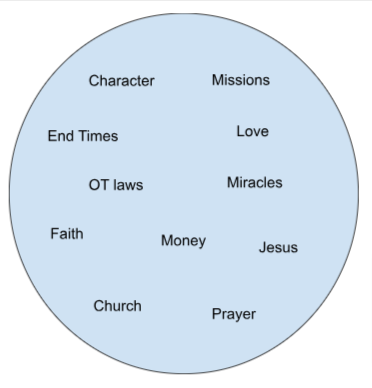
- The Bible is seen as one “materially” binded book containing a collection of thoughts on various topics that are relevant to life and sanctification.
- Pro: Topical study can be very helpful and illuminating to specific areas (i.e. There is much to learn about leadership or marriage in the Bible)
- Con: The Bible tends to become for people something that’s only helpful as it pertains to a circumstance or an interest of the reader at a particular time. Because of that, people will often find parts of the Bible uninteresting and unengaging because it doesn’t fit into a topic that is relevant to your circumstances (i.e. Reading through the Law of Moses, or Revelation, or genealogies)
2) One redemptive story culminating in Christ
How do Jesus and the apostles approach the Bible?
John 5:37-40 -A CAUTION and encouragement for us. You can know the Word without knowing the Word. What will be the evidence that you know the Word? You will believe in the One to which the Scriptures bear witness about. Encouragement is to seek Christ in his Word and you will find Him everywhere. The one who truly knows the Word will be those most filled with faith, obedience, devotion, praise, fruit of the Spirit. You cannot know the Word without knowing Christ.
Luke 24:27– Jesus went through the whole Bible and interpreted it all to show himself in all the Word to these two men.
Luke 24:44-47– “everything written about me in the Law of Moses and the Prophets and the Psalms must be fulfilled…Then he opened their minds to understand the Scriptures. We need this very thing to take place. To have our spiritual minds opened to see Christ as preeminent in the Bible. To see that he is the glorious apex of the story that gives illumination to the whole of the Bible.
Colossians 2:1-4- Where has God hidden all the treasures of wisdom and knowledge?
Hebrews 1:1-2– Christ is God’s final word and fullest revelation of himself and his Word. He is the heir of all things. All things will be subjected to Christ.
2 Corinthians 1:20– All the promises of God find their YES in Christ.
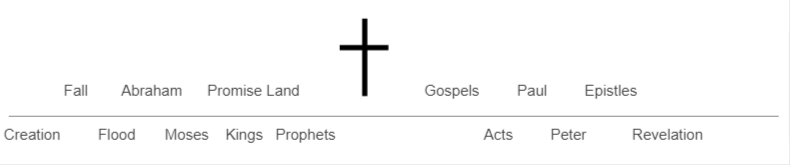
Can we find Christ in ALL of Scripture like He says?
Types– (People or events that signify and embody similar defining features of another to come)
Adam: Rom. 5:14-21- Death spread abroad vs life spread abroad; Life-filled Bride coming from their sides, sanctified through water and blood (Gen. 2:21-25: Eve given life from Adam’s side, Eph. 5:25-33: Church is the Body of Christ and have life from his “sleep” and Heb. 10:22 “sprinkled and washed”, John 19:34 and 1 John 5:6).
Moses: Ex. 2:10-11- born into royalty, yet Hebrew reflects Christ’s divinity and humanity. Gave up his royal rights to save a people from slavery (Hebrews 11:23-28) He became poor to make many rich (2 Corinthians 8:9).
Jonah- The sign of Jonah (Luke 11:29-32) Jonah spent 3 days and 3 nights in the belly of the great fish (Jonah 1:17). Jonah was thrown into the sea to die in order to appease God who was causing the storm. Jonah “resurrected”.
Isaac- Gen. 22:1-14- Abraham’s one and only son of promise, offered up to God. 3-day event, bound to wood, lamb to be provided vs a ram on Mt. Moriah.
Can you think of more?
Foreshadowing– (hints, warnings, inklings, prefigures of the future)
Gen. 3:14-24 – Heel bruising the head of the serpent Christ became a curse for us in order to redeem us from the curse (Galatians 3:13). How does Christ redeem us from the curse:
Gen. 3:15—>Heb. 2:14 (Offspring of woman destroys the devil), Gen. 3:15 and Gen. 4:4-5,8-11—> 1 John 3:10-16, Gen. 3:16—>John 16:20-22 and Rom. 8:22-23, Gen. 3:16—>Eph. 5:22-25 and Rev. 14:4, Gen. 3:17-18 “Futility”—> Matt. 27:29 and Rom. 7:4-5, Gen. 3:19a (What is sweat a product of?)—> Ezekiel 44:16-18 and Matt. 22:39-46 (Contrast between Jesus and disciples in the garden), Gen. 3:19b—>1 Cor. 15:47-49, Gen. 3:24—>Ex. 26:31-33 and Matt. 27:50-54 and Hebrews 10:19-23
Prophecy– (a definite prediction of the future under divine inspiration)
Isaiah 53, Isaiah 9:1-7 (see verses 1-2 in connection with Galilee and Isaiah 8 The Assyrian Invasion.)—> Matthew 4:12-17, Samuel 7:10-16—>Matt. 1:1-17
Symbols– (Objects/events that have somewhat hidden meaning as they are used in repetition)
See 1 Corinthians 10:1-22 (See how Paul uses the OT stories as symbols for us today) Exodus story is a symbol of salvation that Christ ultimately brings to his people. The arc is a symbol of Christ, sheltering people from the wrath of God. Jacob’s ladder- Gen. 28:10-12 and John 1:51 (Christ is the ladder, the mediator between God and man, heaven and earth) Jesus is the true bread that comes down from heaven-John 6:29-35.
Redemptive History-
Set all the types and symbols aside. Looking at the OT we see God’s character, his nature, and his acts on display. There are truths laid out in Scripture that draw a straight line through Genesis to Revelation. Here are some but not all:
Human depravity: An honest reading through the whole Bible will paint this truth in every book of the Bible. There is a corruption in Adam’s race that destroys men’s hearts, breaks relationships and leads whole nations astray. (i.e. Kings, Prophets, NT). Is not Christ the ultimate conqueror of human depravity, when His death and resurrection is effective to give us humanity a new nature that walks in a manner pleasing to God? Romans 8:3-4, “For God has done what the Law, weakened by the flesh, could not do. By sending his own son in the likeness of sinful flesh and for sin, he condemned sin in the flesh, in order that the righteous requirement of the law might be fulfilled in us…”
Salvation in God alone: God is the one who covered Adam and Eve with garments, God is the one who preserved Noah in the arc, God is the one who called Abram, God is the one who upheld the covenant between Him and Abram, God is the one who delivered the Hebrews from Egypt, God alone gave Israel victory over enemies, God alone preserved his people, God alone fulfilled his promise to bring his people back from exile. Is not Christ the champion of eternal salvation as Peter says in Acts 4:12 “And there is salvation in no one else, for there is no other name under heaven given among men by which we must be saved.” Christ alone took on the wrath of God while his disciples slept and fled.
Repentance: David was restored through repentance, the people of Israel were promised rest and cleansing if they would repent, no one was ever right in God’s sight in the Bible without some sort of turning to God and trusting. Is not Jesus the truest fulfillment of true repentance when his sacrifice effectuates true contrition and repentance? Peter says in Acts 5:31 “God exalted him at his right hand as Leader and Savior, to give repentance to Israel and forgiveness of sins.”
God ransoming a people: Ex. 19:5 “Now therefore, if you will indeed obey my voice and keep my covenant, you shall be my treasured possession among all the people among all the people, for all the earth is mine; and you shall be to me a kingdom of priests and a holy nation.” Is not Jesus the champion of all of redemptive history when his death and resurrection effectuates 1 Peter 2:9 “But you are a chosen race, a royal priesthood, a holy nation, a people for his own possession, that you may proclaim the excellencies of him who called you out of darkness into his marvelous light.”?
Can you think of more?
Christ is not simply found in the OT through types and symbols but seeing how all of redemptive history finds its culmination in Him.
 fmi360