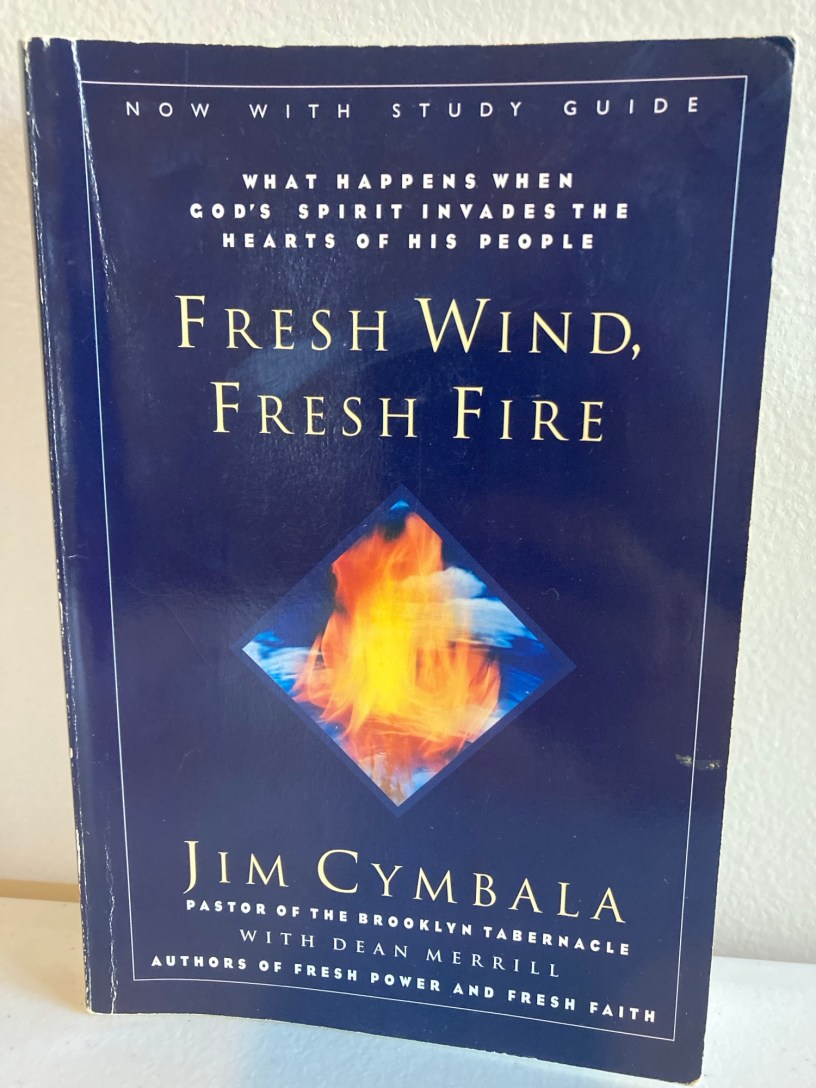
Taken primarily from Jim Cymbala’s, Fresh Wind, Fresh Fire. All references to page numbers come from that book.
“If we call upon the Lord, he has promised in his Word to answer, to bring the unsaved to himself, to pour out his Spirit among us. If we don’t call upon the Lord, he has promised nothing – nothing at all. It’s as simple as that…the future will depend upon our times of prayer.”
(27)
“You can tell how popular a church is by who comes on Sunday morning.
“You can tell how popular the pastor or evangelist is by who comes on Sunday night.
“But you can tell how popular Jesus is by who comes to the prayer meeting.”
(28)
“…the great Scottish devotional writer Andrew Bonar wrote in 1853: ‘God likes to see His people shut up to this, that there is no hope but in prayer. Herein lies the Church’s power against the world.’”
(29)
“…as Samuel Chadwick said long ago, the greatest answer to prayer is more prayer.”
(29)
“Prayer…has to be born out of a whole environment of felt need. If I say, ‘I ought to pray,’ I will soon run out of motivation and quit; the flesh is too strong. I have to be driven to pray.”
(49)
“PRAYER IS THE SOURCE of the Christian life, a Christian’s lifeline. Otherwise, it’s like having a baby in your arms and dressing her up so cute – but she’s not breathing!”
(50)
- Acts 2:42 – “We are not New Testament Christians if we don’t have a prayer life…This conviction makes us squirm a little, but how else will there be a breakthrough with God?” (50)
The quality of a church’s or a person’s prayer is the most reliable indicator of that church’s or person’s spiritual health. It is the test of whether we are alive.
- Genesis 4:25-26 – God’s first people were not called “Jews” or “the children of Israel” or “Hebrews.” In the very beginning their original name was “those who call on the name of the Lord.”
“…calling out to God with passion for needs…That is the literal meaning of the Hebrew word used countless times in the Old Testament when people called upon God. It means to cry out, to implore aid. This is the essence of true prayer that touches God.” (55)
“Charles Spurgeon once remarked that ‘the best style of prayer is that which cannot be called anything else but a cry.’” (55)
- Deut. 4:7 – After Moses came down from Mt. Sinai, calling on God became an earmark of his people’s successes.
- Acts 2:21 – Salvation itself is impossible until a person humbly calls upon the name of the Lord
- Psalm 80:18 – “prayer begets revival, which begets more prayer” (58)
- Mark 11:15-18 – Essentially the same incident happened twice, once shortly after the beginning of Jesus’ ministry and once during the last week before the crucifixion. The first time (John 2), Jesus even made a whip out of cords. He was physically driving people out of the temple. (68)
“Does the Bible ever say, anywhere from Genesis to Revelation, ‘My house shall be called a house of preaching’?
“Does it ever say, ‘My house shall be called a house of music’?
“Of course not.
“The Bible does say, ‘My house shall be called a house of prayer for all nations.’”
(71)
- Acts 1:13-14; 2:1-4 – “Jesus launched the Christian church, not while someone was preaching, but while people were praying? In the first two chapters of Acts, the disciples were doing nothing but waiting on God.” (72)
- Acts 4 – when apostles were unjustly arrested, imprisoned, and threatened…they headed to a prayer meeting. Soon the place was vibrating with the power of the Holy Spirit (vv. 23-31).
“British Bible translator J.B. Phillips…could not help reflecting on what he had observed [in Acts]. In the 1955 preface to his first edition of Acts, he wrote:
The reader is stirred because he is seeing Christianity, the real thing, in action for the first time in human history. The newborn Church, as vulnerable as any human child, having neither money, influence nor power in the ordinary sense, is setting forth joyfully and courageously to win the pagan world for God through Christ…
Yet we cannot help feeling disturbed as well as moved, for this surely is the church as it was meant to be. It is vigorous and flexible, for these are the days before it ever became fat and short of breath through prosperity, or muscle-bound by over organization. These men did not make ‘acts of faith,’ they believed; they did not ‘say their prayers,’ they really prayed. They did not hold conferences on psychosomatic medicine. They simply healed the sick.
- Acts 9 – v. 11: the proof that Paul had changed and was a believer was that he was praying
- Ro. 10:13-15 – Sending leads to preaching. Preaching leads to hearing. Hearing leads to believing. Believing leads to calling on the name of the Lord. Believing is not the climax.
- 1 Timothy 2:1 – clearest instructions about church life come in the Pastoral Letters, where Paul tells young pastors such as Timothy how to proceed. Prayer is said to be the first thing the believers were to do. Why? God’s house is to be called a house of prayer.
- 1 Timothy 2:8 – Paul repeats the call to pray
- Rev. 1-3 shows instructions and prophecy for churches of John’s time. Rev. 4:1 – Rev. 22: shows instruction and prophecy for church for rest of age. Rev. 5 talks about the scroll that unveils the history of the church. Rev. 5:1 shows the scroll, 5:3-4 shows no one could open the scroll to see the histories of the church, 5:6-7 shows that Jesus was able to open the scroll…
- Rev. 5:8 reveals that before the scroll was opened, the prayers of the saints were received. Since the scroll shows the history of the church, it is clear that the prayers of the saints are what dictate (and change) that history. In fact, we see that the prayers are kept in golden bowls by the elders. When we pray, it’s so precious to God that He keeps it as a treasure.
- Matt. 7:7; Jer. 29:13; James 4:2 – Bible has these promises. Isn’t it time to say, “Stop! We’re going to pray, because God said that when we pray, He will intervene.”
- Hebrews 4:16 – It doesn’t say, “Let us come to the sermon.” Preachers who are really doing their job get people to come to the throne of grace. That’s the true source of grace and mercy.
“I am well aware that we don’t get everything we ask for; we have to ask according to God’s will. But let us not use theological dodges to avoid the fact that we often go without things God wants us to have right now, today, because we fail to ask. Too seldom do we get honest enough to admit, ‘Lord, I can’t handle this alone. I’ve just hit the wall for the thirty-second time and I need you.’”
(85)
E.M. Bounds wrote, “Prayer ought to enter into the spiritual habits, but it ceases to be prayer when it is carried on by habit only…Desire gives fervor to prayer…Strong desires make strong prayers…The neglect of prayer is the fearful token of dead spiritual desires…There can be no true praying without desire.”
(85-6)
David and Goliath. Goliath is the enemy and strong man against David (a picture of Satan ). He is irritated and upset with David (1 Sam. 17:43-44). But look at David’s response: “As the Philistine moved closer to attack him, David ran quickly toward the battle line to meet him” (v. 48).
“That is the picture of what God wants for us today: running toward the fray!
“David’s weaponry was ridiculous: a sling and five stones. It didn’t matter. God still uses foolish tools in the hands of weak people to build his kingdom. Backed by prayer and his power, we can accomplish the unthinkable.”
v
- Rev. 2:10 – To Smyrna, Christ warns that they are in a hostile environment and there are no quick fixes.
- Rev. 2:13 – To Pergamum, a similar picture – Satan is not going to leave quickly. It will be a constant struggle, but believers need to prevail.
- James 4:8 – the responsibility to pray lies with us
“Revivals have never been dominated by eloquent or clever preaching. If you had timed the meetings with a stopwatch, you would have found far more minutes given to prayer, weeping, and repentance than to sermons. In the “Prayer Meeting Revival” of 1857-59 there was virtually no preaching at all. Yet it apparently produced the greatest harvest of any spiritual awakening in American history: estimates run to 1,000,000 converts across the United States, out of a national population at that time of only 30,000,000. That would be proportionate to 9,000,000 Americans today falling on their knees in repentance!
“How did this happen? A quiet businessman named Jeremiah Lanphier started a Wednesday noon prayer meeting in a Dutch Reformed church in New York City, no more than a quarter mile from Wall Street. The first week, six people showed up. The next week, twenty came. The next week, forty…and they decided to have daily meetings instead.
“There was no fanaticism, no hysteria, just an incredible movement of people to pray.’ Reports J. Edwin Orr. ‘The services were not given over to preaching. Instead, anyone was free to pray.’
“During the fourth week, the financial Panic of 1857 hit; the bond market crashed, and the first banks failed. (Within a month, more than 1,400 banks had collapsed.) People began calling out to God more seriously than ever. Lanphier’s church started having three noontime prayer meetings in different rooms. John Street Methodist Church, a few doors east of Broadway, was packed out as well. Soon Burton’s theater on Chambers Street was jammed with 3,000 people each noon.
“The scene was soon replicated in Boston, New Haven, Philadelphia, Washington, and the South. By the next spring 2,000 Chicagoans were gathering each day in the Metropolitan Theater to pray. A young 21-year-old in those meetings, newly arrived in the city, felt his first call to do Christian work. He wrote his mother back East that he was going to start a Sunday school class. His name was Dwight L. Moody.
“Does anyone really think that America today is lacking preachers, books, Bible translations, and neat doctrinal statements? What we really lack is the passion to call upon the Lord until He opens the heavens and shows himself powerful.”
(149-50)
2 Chronicles 14:2-4 – King Asa “did what was good and right in the eyes of the Lord his God.” He demolished the idolatry. He commanded Judah to seek the Lord, and obey God’s laws and commands.
10 years later, though, Asa’s people were invaded by the huge Ethiopian (Cushite) army. This shows that godliness does not promise smooth sailing. But look at Asa’s response in 2 Chron. 14:11. He knew to call on God when the enemy attacked, and God delivered the Israelites from the attack (see 2 Chron. 14:12-14).
On Asa’s way home from the battle, a prophet told him a principle that is just as true then as it is today: READ 2 Chron. 15:2 – God’s participation in our lives is directly related to our seeking Him.
After seeking God even more, Asa realized that there was more repentance and demolition for Israel (2 Chron. 15:16, for example).
25 years went by, and somewhere along the way, ASA STOPPED FEELING THE NEED TO SEEK GOD.
2 Chron. 16 shows us that the Israelites were later attacked by another army (much smaller than the Ethiopians).
So what did Asa do? He decided to make a treaty with another king to get help (not God). (see 2 Chron. 16:2-3).
The king was willing to be bought by Asa, and he helped Asa in destroying the enemy. In other words, the plan worked, and Asa was able to escape his enemies through his own craftiness (instead of relying on God).
Soon, a prophet named Hanani gave Asa a stern rebuke from the Lord (READ 2 Chron. 16:7-9), but he would not listen. Instead, he put Hanani in prison and started brutally oppressing some of his people.
As an old man Asa would develop a painful case of foot trouble, probably gout. But even then: “Though his disease was severe, even in his illness he did not seek help from the Lord, but only from the physicians. Then in the forty-first year of his reign Asa died.” (2 Chron. 16:12-13).
This picture is pitiful. Here was a man who used to cry out to God, and God answered him powerfully. Yet, he felt he reached a level of maturity where it was no longer as necessary to call out to God. As a result, God allowed him to be conquered and die of a painful disease.
Azariah’s words could not be more pertinent to Asa’s situation (and the situation for all Christians today): “The Lord is with you while you are with Him. If you seek Him, He will be found by you; but if you forsake Him, He will forsake you.” (2 Chron. 15:2).
INTERCESSION…
- 1 Chron. 12:18 – the merging of divine and human effort is seen.
“In verses 12-14 [of 1 Chronicles] we meet Eleazar, who accompanied David into a major battle with the Philistines…
“…Once again we see the combination of human and divine efforts. God did not act alone…Instead, He was looking all across the horizon that day to see who would stay in the barley field and thus receive his supernatural aid. While others left in fear, these two – David and Eleazar – stood firm. [INTERCESSION]
“The account in 2 Samuel 23:10 adds even more detail about Eleazar. He ‘stood his ground and struck down the Philistines till his hand grew tired and froze to the sword.’ He swung his weapon with such grit, such adrenaline, that his muscles locked up on him; he couldn’t let go. Talk about a mighty warrior for God!” (173-4) [BIBLE]
Eleazar was not a big name like David, but was just as important to the kingdom. He fought alongside David (who is a type for Jesus) in the field, and when he fought he used the sword like a warrior. This is a picture of intercession, and intercession with the power of the Word of God (the sword).
“When Charles Finney preached in Rochester, New York, in the 1820s, more than 100,000 people came to Christ within a year. ‘The whole community was stirred,’ according to one eyewitness. ‘Grog [liquor] shops were closed; the Sabbath was honored; the sanctuaries were thronged with happy worshipers…Even the courts and the prisons bore witness to [the] blessed effects. There was a wonderful falling off in crime. The courts had little to do, and the jail was nearly empty for years afterward.’” (115). But this was only half of the story…
“A man such as Eleazar brings to mind the little-known, seldom-seen partner of the great evangelist Charles Finney during the Second Great Awakening. His name was Daniel Nash, and he had had a lackluster record as a pastor in upstate New York. He finally decided, at the age of forty-eight, to give himself totally to prayer for Finney’s meetings.
“’Father Nash,’ as some called him, would quietly slip into a town three or four weeks before Finney’s arrival, rent a room, find two or three other like-minded Christians to join him, and start pleading with God. In one town the best he could find was a dark, damp cellar; it became his center for intercession.
“In another place, Finney relates,
When I got to town to start a revival a lady contacted me who ran a boarding house. She said, “Brother Finney, do you know a Father Nash? He and two other men have been at my boarding house for the last three days, but they haven’t eaten a bite of food. I opened the door and peeped in at them because I could hear them groaning, and I saw them down on their faces. They have been this way for three days, lying prostrate on the floor and groaning. I thought something awful must have happened to them. I was afraid to go in and I didn’t know what to do. Would you please come see about them?”
“No, it isn’t necessary,” I replied. “They just have a spirit of travail in prayer.”
“Once the public meetings began, Nash usually did not attend. He kept praying in his hideaway for the conviction of the Holy Spirit to melt the crowd. If opposition arose – as it often did in those rugged days of the 1820s – Finney would tell him about it, and Father Nash would bear down all the harder in prayer.
“One time a group of young men openly announced that they were going to break up the meetings. Nash, after praying, came out of the shadows to confront them. ‘Now, mark me, young men! God will break your ranks in less than one week, either by converting some of you, or by sending some of you to hell. He will do this as certainly as the Lord is my God!’
“Finney admits that at that point he thought his friend had gone over the edge. But the next Tuesday morning, the leader of the group suddenly showed up. He broke down before Finney, confessed his sinful attitude, and gave himself to Christ.
“’What shall I do, Mr. Finney?’ he asked then. The evangelist sent him back to tell his companions what had changed in his life. Before the week was out, ‘nearly if not all of that class [group] of young men were hoping in Christ,’ Finney reported.
“In 1826 a mob in a certain town burned effigies of the two: Finney and Nash. These unbelievers recognized that one man was as big a threat to their wickedness as the other.
“Shortly before Nash died in the winter of 1831, he wrote in a letter,
I am now convinced, it is my duty and privilege, and the duty of every other Christian, to pray for as much of the Holy Spirit as came down on the day of Pentecost, and a great deal more…My body is in pain, but I am happy in my God…I have only just begun to understand what Jesus meant when he said, “All things whatsoever ye shall ask in prayer, believing, ye shall receive.”
“Within four months of Nash’s death, Finney left the itinerant field to become the pastor of a church in New York City. His partner in cracking the gates of hell was gone. If you want to see Father Nash’s grave today, you will have to drive to northern New York, almost to the Canadian border. There, in a neglected cemetery along a dirt road, you will find a tombstone that says it all:
DANIEL NASH
LABORER WITH FINNEY
MIGHTY IN PRAYER
NOV. 17, 1775 – DEC. 20, 1831
“Daniel Nash was a nobody to the elite of his time. They would have found this humble man not worthy of comment because he lived on a totally different plane. But you can be sure that he was known all too well in both heaven and hell.”
(174-7)
 fmi360